You need a high flow skid steer when the hydraulic attachments you plan to use require more oil flow than a standard-flow machine can provide. If your regular work mainly uses a bucket, pallet forks or other tools with little or no continuous hydraulic demand, paying for high flow may add little practical value.
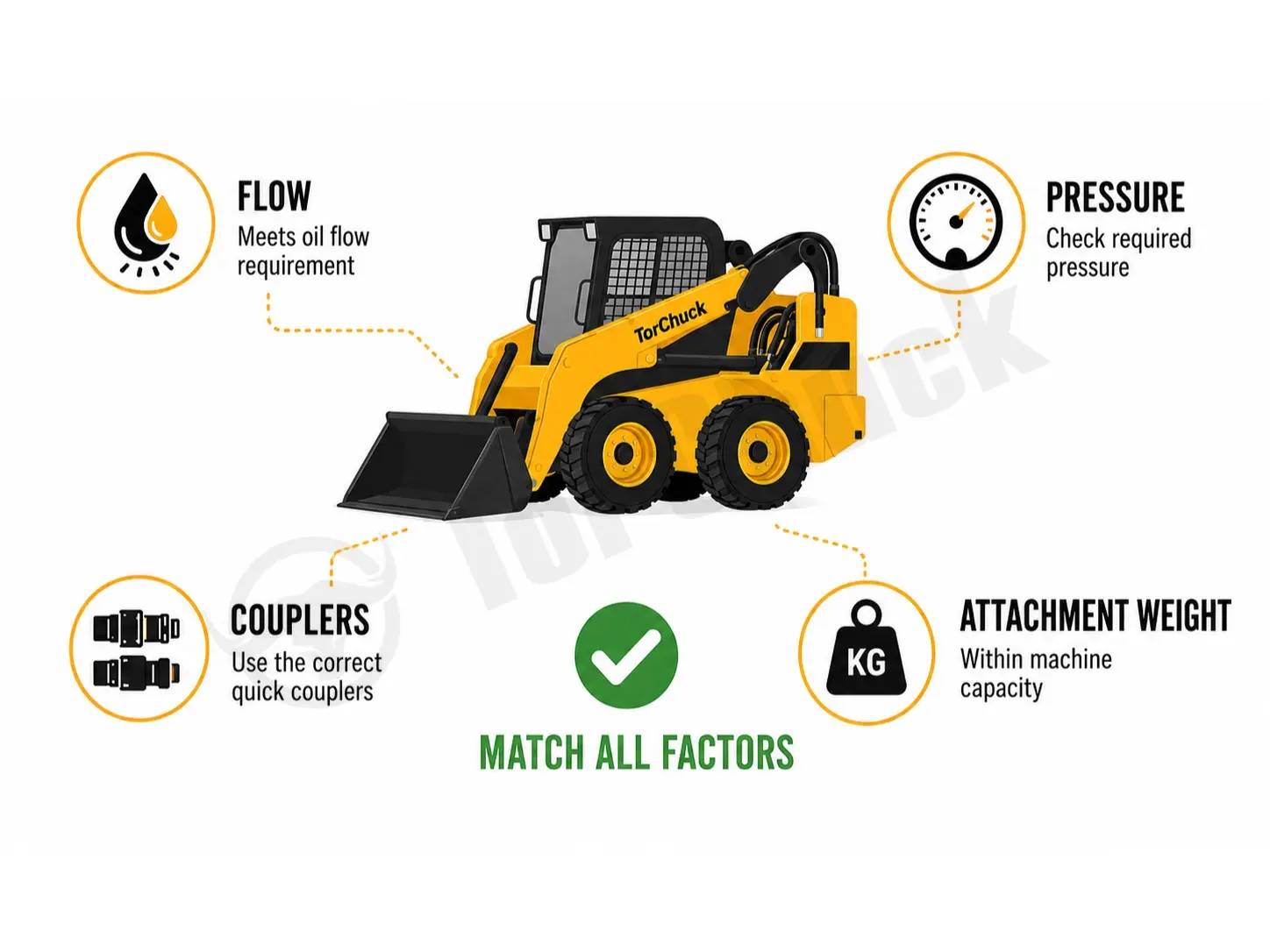
This is why the attachment should be part of the skid steer selection from the beginning. Flow, pressure, couplers, attachment weight and machine capacity all need to work together.
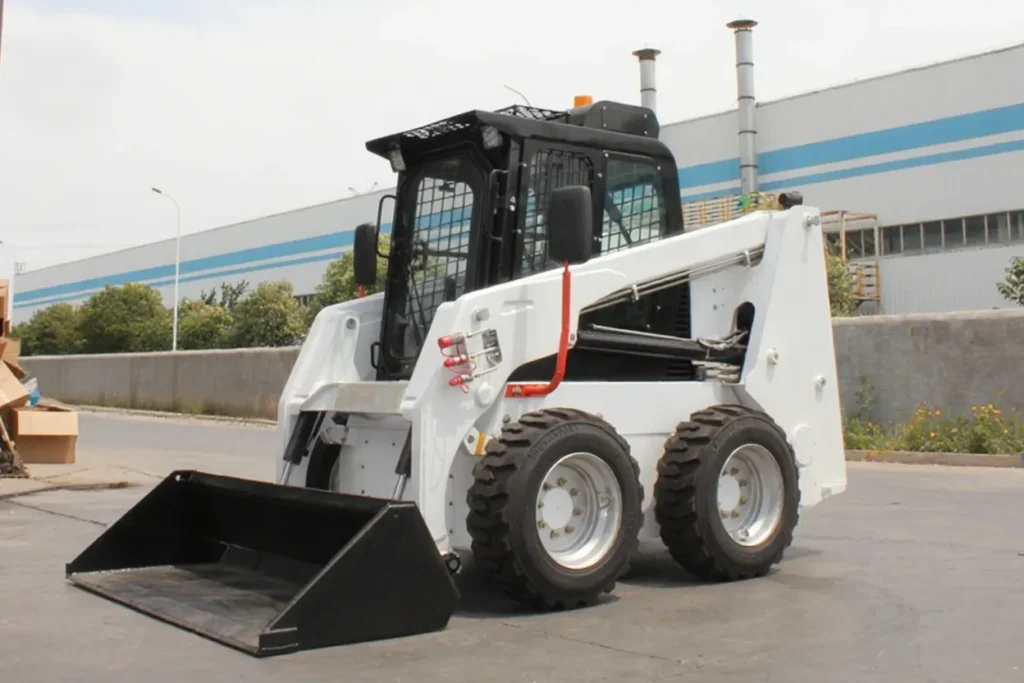
Torchuck supplies both standard and high-flow configurations across its skid steer loader range, together with more than 50 attachment options. The better buying question is therefore not “Is high flow better?” but “What hydraulic system does my work actually need?”
What Is the Difference Between Standard Flow and High Flow?
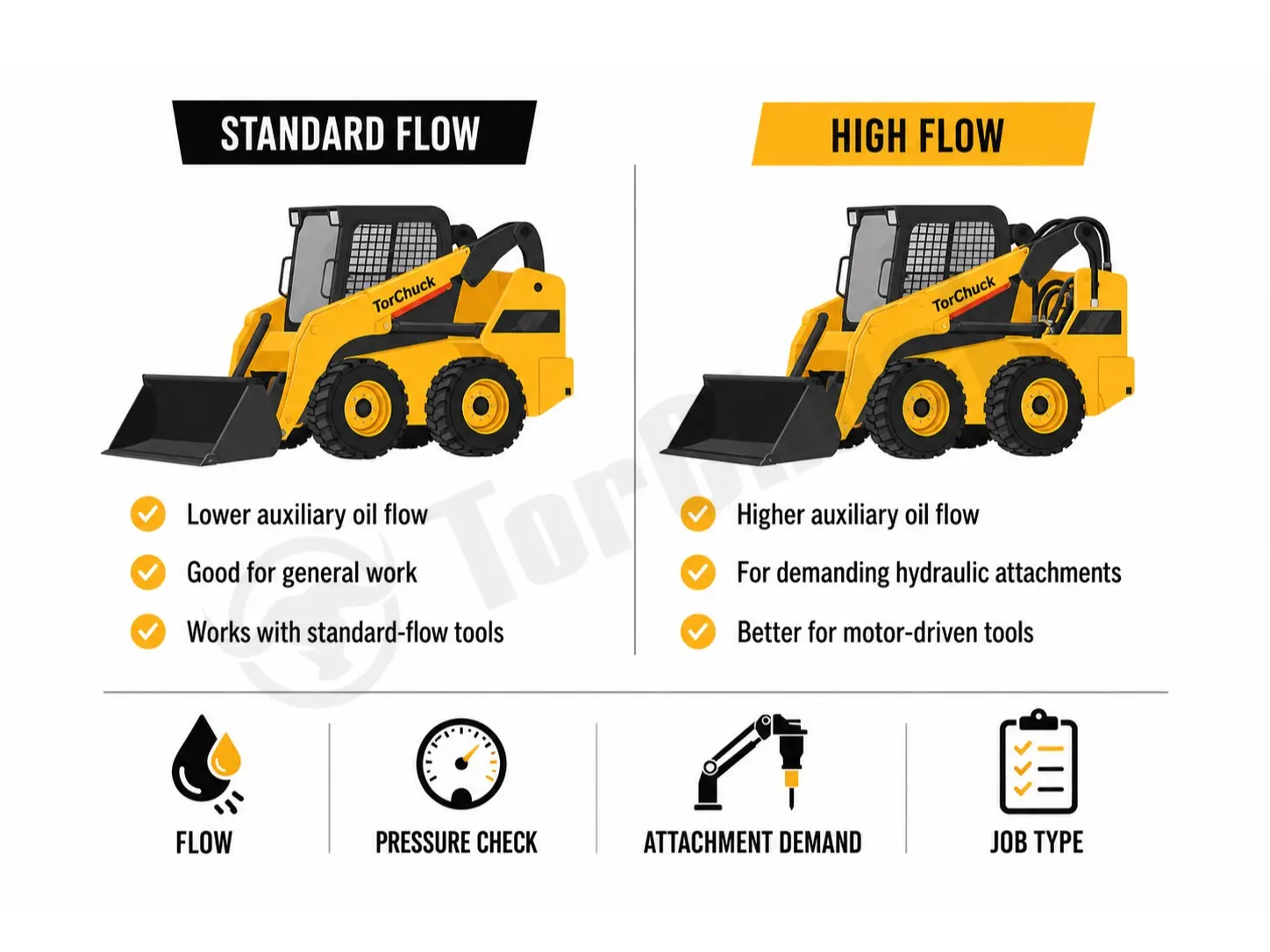
Both systems use hydraulic oil to power attachments. The main difference is how much hydraulic flow the auxiliary circuit can supply.
Flow describes how much hydraulic fluid moves through the system over time. Pressure describes the resistance the system can work against. These two figures are related, but they are not the same thing. A hydraulic pump creates flow, while system resistance creates pressure. Hydraulic systems use pressurized liquid to transmit and control power.
Standard flow is suitable for many common skid steer jobs. High flow provides a larger volume of hydraulic oil to an attachment that is designed to use it. This becomes important with tools that use hydraulic motors continuously, especially when the attachment needs more hydraulic power to maintain cutting, grinding or milling performance.
The exact flow rate is machine-specific. There is no useful universal number that separates every standard-flow skid steer from every high-flow model. Different manufacturers and machine classes use different systems, so buyers should compare the published specifications of the host machine and attachment.
| Item | Standard Flow | High Flow |
|---|---|---|
| Auxiliary oil flow | Lower | Higher |
| Typical purchase need | General-purpose work | More demanding hydraulic attachments |
| Attachment compatibility | Standard-flow tools | High-flow tools and, depending on the machine, some standard-flow tools |
| Best reason to choose it | Your regular tools do not need additional flow | Your regular tools specifically require or benefit from higher flow |
| What still needs checking | Pressure, couplers, return line, attachment weight | Pressure, couplers, return line, cooling and attachment weight |
High flow should therefore be treated as a working specification, not a badge showing that one skid steer is automatically better than another.
Do You Really Need High Flow?
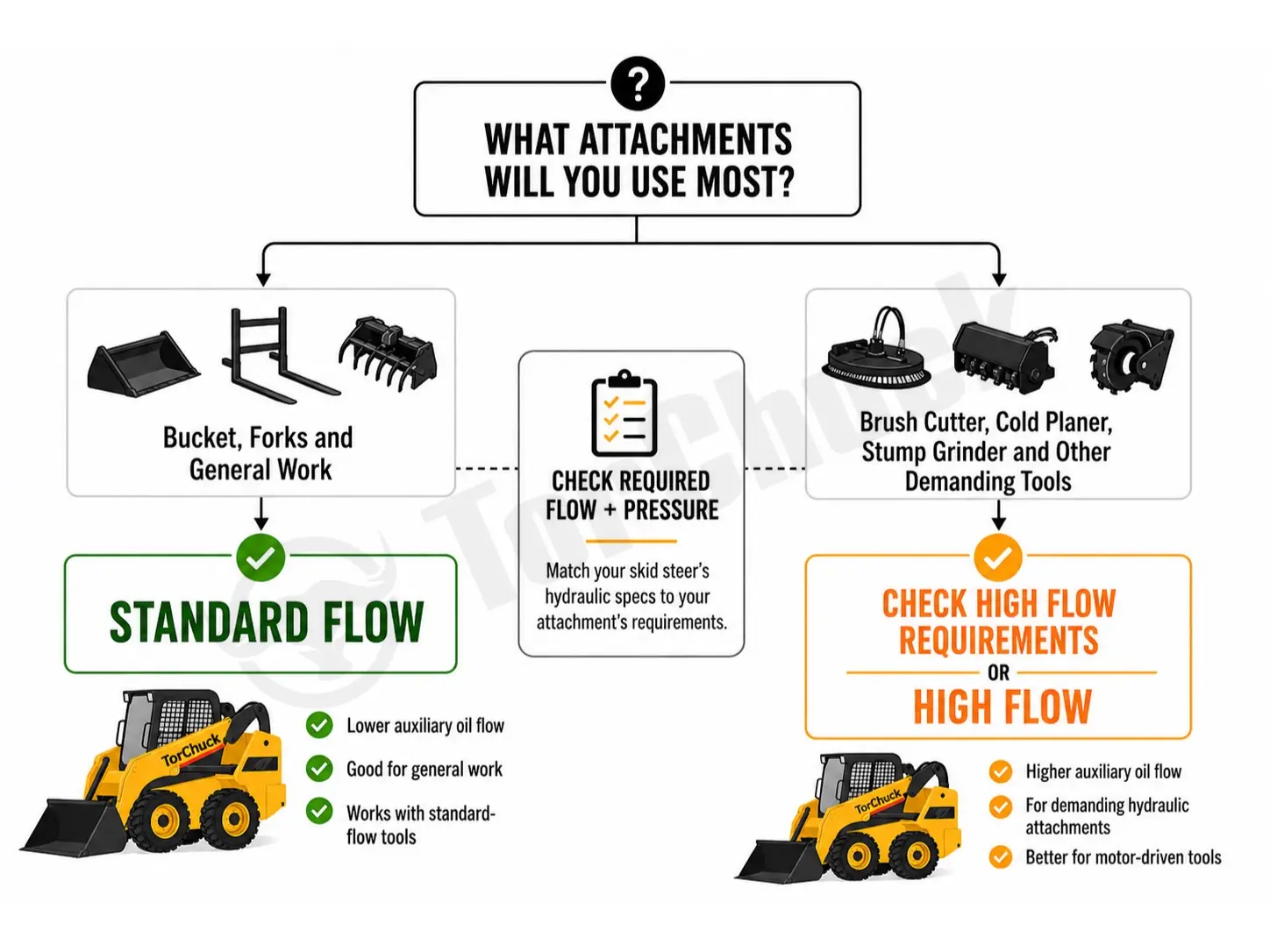
Start with the attachments you expect to use most.
For loading soil, moving pallets, carrying materials or grading with a standard bucket, the attachment itself does not need a continuous high-flow hydraulic motor. Choosing high flow only because it sounds more powerful will not automatically make those basic jobs better.
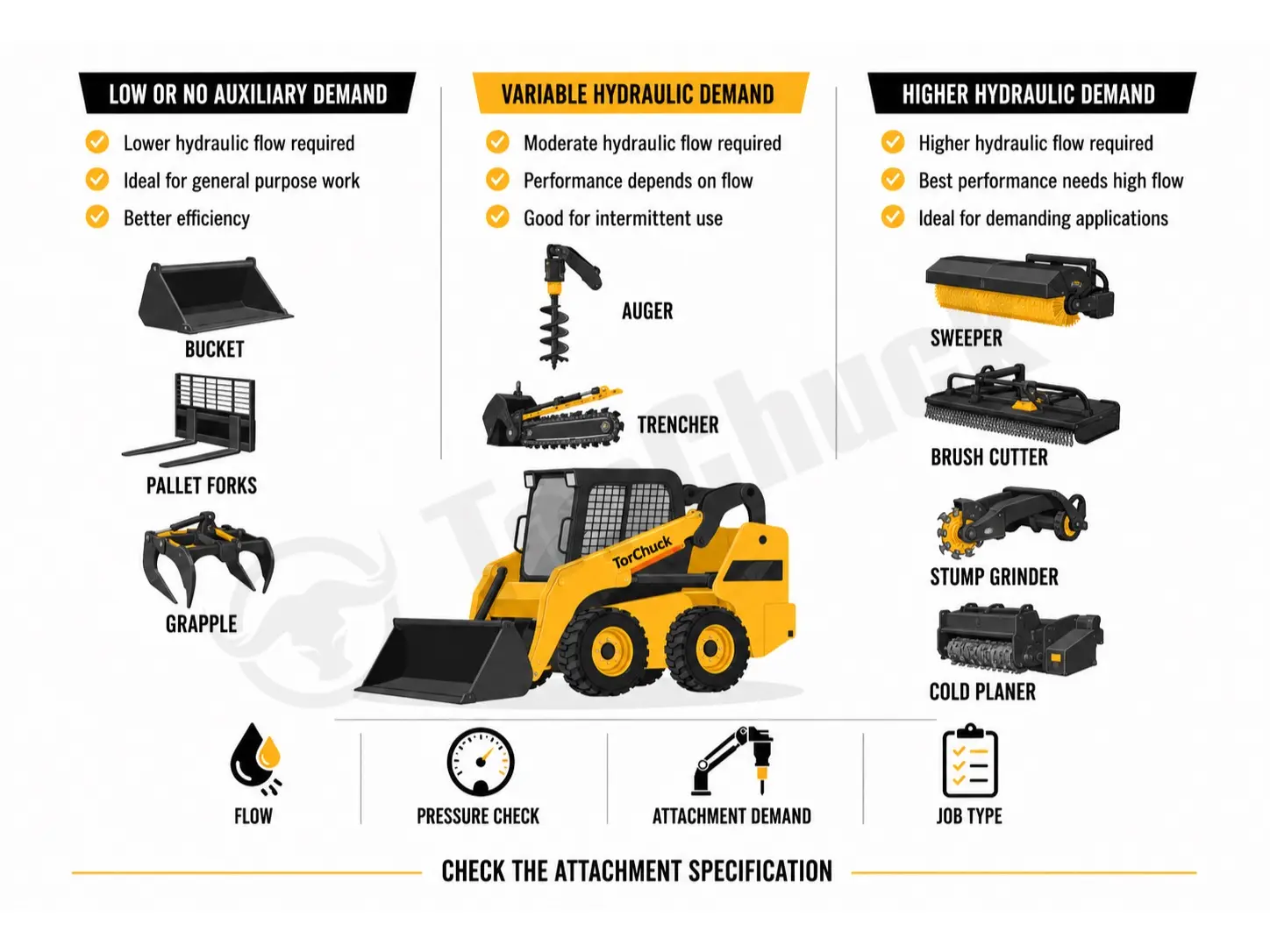
Things change when the attachment uses a hydraulic motor for continuous cutting, grinding, sweeping or milling. Some versions of cold planers, large brush cutters, forestry mulchers, stump grinders and similar tools are built for higher hydraulic demand. Torchuck’s current heavy skid steer page specifically mentions cold planers and large brush cutters as examples of demanding attachments that may use high-flow hydraulics.
Still, the attachment name alone is not enough.
A brush cutter from one manufacturer may be designed for standard flow, while another version of a similar-sized cutter may need high flow. Trenchers, sweepers, augers and stump grinders are also available in different hydraulic configurations.
That is why “brush cutter = high flow” or “trencher = standard flow” is too simple. The correct answer comes from the attachment specification.
If the attachment manufacturer gives a required hydraulic flow range and pressure range, the skid steer should be matched to those figures. Buying the machine first and checking the tool later creates unnecessary risk.
Which Skid Steer Attachments May Need High Flow?
Hydraulic demand usually becomes more important when the attachment depends on continuous motor speed under load.
A cold planer is a good example. Its drum needs to keep rotating while cutting pavement. Larger brush cutters and forestry attachments also need steady hydraulic power while the cutting head works through vegetation. Some stump grinders place similar demands on a hydraulic motor while the wheel is cutting.
Other tools can fall into either category depending on their design. Augers, trenchers, sweepers and smaller cutters may have standard-flow versions as well as models made for higher-flow machines.
Meanwhile, attachments such as pallet forks and standard buckets do not use auxiliary hydraulic flow at all. A grapple needs hydraulics to open and close, but that does not automatically mean it needs a high-flow circuit.
A more useful way to compare attachments is this:
| Attachment Type | Hydraulic Demand | What to Check |
|---|---|---|
| Standard bucket | None for normal bucket operation | Machine capacity and coupler |
| Pallet forks | None | Rated operating capacity and fork rating |
| Grapple | Hydraulic function, usually intermittent | Required flow, pressure and couplers |
| Auger | Hydraulic motor | Flow and pressure required by the auger drive |
| Trencher | Hydraulic motor | Required flow, pressure and working depth |
| Brush cutter | Varies widely by model | Required flow, pressure and cutter specification |
| Stump grinder | Varies by model | Required flow, pressure, attachment weight |
| Cold planer | Often higher hydraulic demand | Required flow, pressure and host-machine compatibility |
| Forestry mulcher | Frequently demanding | Required flow, pressure, cooling and machine capacity |
This table should not be used as a substitute for the attachment manual. It shows why attachment categories alone cannot determine the correct hydraulic package.
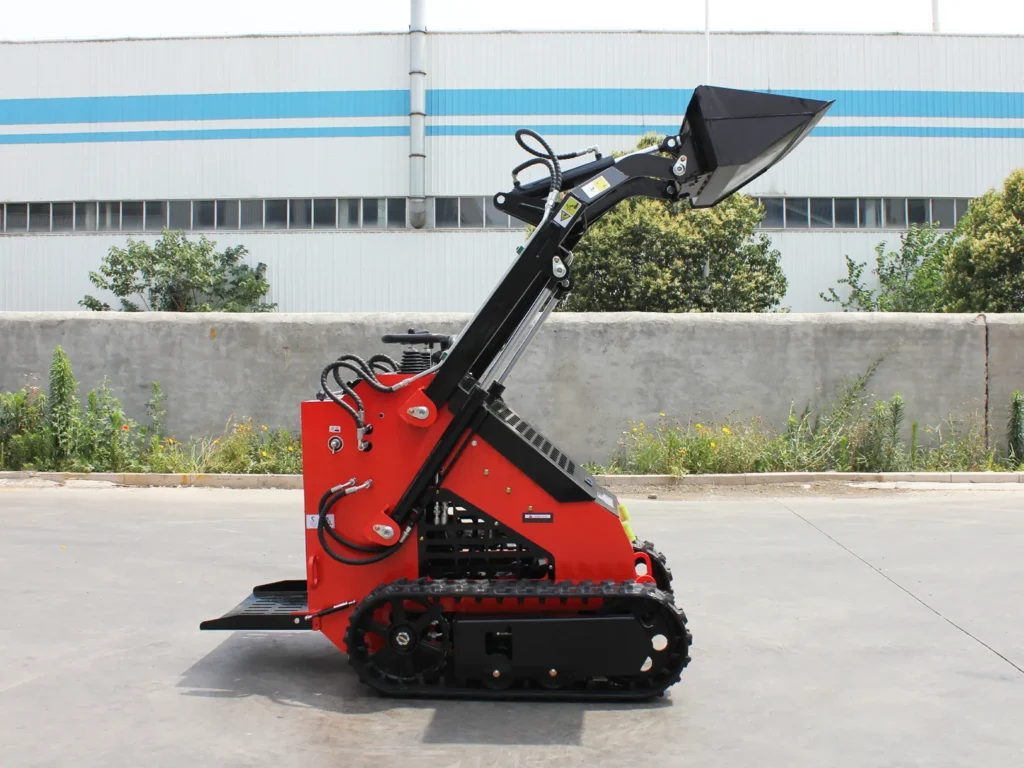
Torchuck’s mini skid steer loader range includes augers, trenchers, brush cutters, pallet forks, grapples, stump grinders, 4-in-1 buckets and sweepers. Torchuck also offers standard and high-flow options for suitable machines, so the attachment package can be considered before the skid steer is configured.
Why Flow and Pressure Must Be Checked Together
Buyers sometimes ask only one question: “How much flow does this machine have?”
Flow matters, but it does not describe the whole hydraulic system.
Hydraulic pressure is also part of the attachment specification. If an attachment is designed to operate within a certain flow and pressure range, both values need to be compatible with the host machine. Couplers, hose size, return lines and hydraulic cooling can matter as well.
Think of flow as the amount of oil available to move through the attachment and pressure as the system’s ability to work against resistance. More flow does not simply replace insufficient pressure, and more pressure does not replace the flow required by a hydraulic motor.
This is especially important with attachments that run continuously. Heat builds in hydraulic systems during work, so the skid steer and attachment need to be designed as a compatible package. Selecting an attachment that asks more from the hydraulic circuit than the machine was designed to provide can lead to poor performance and unnecessary heat.
The safest approach is simple: compare the attachment manufacturer’s required flow and pressure with the skid steer’s auxiliary hydraulic specifications before ordering either one.
What Happens If the Attachment and Machine Do Not Match?
A mismatch does not always mean the attachment will refuse to move. Sometimes it will operate, but not in the way the buyer expected.
A hydraulic motor receiving less flow than it was designed for may run more slowly. For a cutter, planer or grinder, that can affect how the tool performs under load. The operator may then try to compensate by moving more slowly or making repeated passes.
Sending an attachment a hydraulic supply outside its specified operating range creates a different problem. Hoses, motors, valves and seals are designed around particular limits. This is why the published limits of both the machine and attachment should be followed.
Connection details can also stop an otherwise suitable combination from working. Correct quick couplers, hose connections and return arrangements need to be confirmed before shipment. Attachment weight and the skid steer’s rated capacity matter too, because hydraulic compatibility does not automatically mean the host machine can safely carry every tool.
Safety remains part of the setup. OSHA advises operators to follow manufacturer recommendations and specifications when operating skid steer loaders, and it stresses proper inspection, maintenance and attachment handling. OSHA’s skid-steer loader safety bulletin also warns against bypassing safety systems or servicing equipment with raised lift arms unless approved supports are used.
In other words, attachment matching is not only about getting enough hydraulic power. The whole machine has to be suitable for the tool.
When Standard Flow Is the Better Choice
High flow is useful, but buying it for every machine does not make sense.
Standard flow can be the better choice when most of the work involves loading, grading, pallet handling or attachments designed specifically for a standard auxiliary circuit. For these buyers, the extra hydraulic capability of a high-flow package may spend most of its life unused.
Rental companies should think about the same issue from a fleet perspective. If most customers rent buckets, forks, grapples and standard-flow augers, a simple hydraulic setup may be easier to manage. If the rental fleet also serves land clearing, road work or customers using demanding motor-driven attachments, high-flow machines become more useful.
Dealers need to look at local attachment demand before deciding what to stock. A market dominated by farms and landscaping may need a different machine mix from one serving forestry, pavement maintenance or heavy vegetation clearing.
Compact size also matters. Torchuck’s mini skid steer range is built around narrow-access work and offers more than 50 attachment options. Some customers need hydraulic versatility, while others care more about machine width, transport and simple operation.
Choosing standard flow when it already covers the regular workload is not buying a lower-quality machine. It is avoiding a configuration the customer does not need.
When High Flow Is Worth Paying For
High flow becomes easier to justify when hydraulic attachments are central to the business rather than occasional extras.
A contractor who spends a large part of the week running a compatible planer, large cutter, mulcher or other demanding motor-driven tool has a very different requirement from someone who mainly loads dirt with a bucket. In that situation, auxiliary hydraulic performance becomes part of the machine’s core productivity.
Future work also deserves some thought. Buyers who already know they plan to add higher-demand attachments should confirm whether the selected skid steer can support them before ordering. Buying around today’s bucket work and ignoring tomorrow’s attachment plan can leave the machine poorly matched later.
However, “I might use high flow someday” is not enough by itself. Ask which attachment is likely to be purchased, then check its published hydraulic specification. That gives the buying decision a real technical basis.
Torchuck’s heavy skid steer loader range includes wheel and track configurations, Standard / High-Flow hydraulics, vertical or radial lift choices and more than 50 attachments. This makes it possible to build the host machine around the planned tools instead of treating hydraulic flow as a standalone upgrade.
Can You Add High Flow Hydraulics to a Skid Steer Later?
Sometimes a machine can be modified, but buyers should not assume that every standard-flow skid steer can be cheaply converted to high flow later.
A true high-flow system may involve more than changing one hose or installing a different coupler. Pump capacity, valves, plumbing, cooling, controls and other components may be part of the original machine design. The required changes depend on the exact skid steer.
Aftermarket modification also raises questions about warranty, system limits and safety. Changing the hydraulic circuit without confirming the manufacturer’s specification can create compatibility and reliability problems.
For a machine you already own, ask the manufacturer or supplier whether an approved high-flow kit exists for that exact model and serial configuration. If no approved solution is available, comparing the cost and risk of modification with a properly configured machine is usually more useful than assuming a conversion will be simple.
For a new purchase, the easier route is to decide on the main attachments before production.
Buy the Attachment and Hydraulic System as One Package
Many purchasing mistakes happen because the skid steer and attachment are treated as two separate orders.
First the buyer chooses the loader. Weeks later, the buyer decides to add a brush cutter or stump grinder. Only then does someone check whether the machine has the required auxiliary flow, pressure, couplers and cooling.
Reversing that sequence makes the decision easier. Start with the work you need to do and identify the main attachments. Then match those attachments to the hydraulic system, rated operating capacity and machine size.
This approach is particularly useful for dealers and rental companies. They are not buying one skid steer for one private job. They need a machine and attachment mix that reflects what local customers actually rent or buy.
Torchuck can supply the skid steer loader and attachment package together. Instead of asking only for horsepower or machine size, customers can share the jobs they expect to perform and the attachments they plan to use. Torchuck can then match a suitable hydraulic configuration before the quotation is finalized.
How Torchuck Matches the Right Hydraulic Setup
Torchuck does not need to recommend high flow to every customer because both standard and high-flow configurations are available.
The selection starts with the application. Share the attachments, daily work, material, machine size, wheel or track preference and destination market. Torchuck can then compare the hydraulic requirements with suitable skid steer configurations and confirm the attachment interface before shipment.
For dealers, the same process can be used to build attachment packages around the local market. Torchuck currently offers more than 50 attachment options and supports both compact mini skid steers and larger wheel or track loaders.
The goal is not to sell the highest hydraulic specification. It is to avoid paying for a system you will not use—or buying a machine that cannot properly run the attachments you need.
Frequently Asked Questions
Do I Really Need a High Flow Skid Steer?
You need high flow when the attachments you regularly use require a hydraulic flow that the standard system cannot provide. If your normal work uses buckets, pallet forks and tools designed for standard flow, high flow may not add much practical value.
Check the attachment specifications before choosing the hydraulic package.
Which Skid Steer Attachments Require High Flow?
There is no reliable list saying every attachment of one type requires high flow. Large brush cutters, cold planers, forestry mulchers and some stump grinders are common examples of attachments that may have higher hydraulic requirements, but standard-flow versions also exist in several attachment categories.
Always check the required flow and pressure of the exact attachment model.
What’s the Difference Between High Flow and Standard Flow on a Skid Steer?
High-flow systems provide more auxiliary hydraulic oil flow than standard-flow systems. This allows compatible attachments with higher hydraulic demand to operate as designed.
Pressure still needs to be checked separately. Higher flow does not mean every part of the skid steer becomes stronger.
Can You Add High Flow Hydraulics to a Skid Steer?
It depends on the machine. Some models may have an approved conversion package, while others would require major changes to pumps, valves, plumbing, cooling or controls.
Check with the manufacturer before modifying an existing hydraulic system.
Does High Flow Make a Skid Steer More Powerful?
Not in every function. High flow mainly affects the auxiliary hydraulic supply available to compatible attachments.
Machine lifting, breakout, traction and rated operating capacity are separate specifications. Buyers should not use the words “high flow” as a substitute for checking the whole machine.
Can a High Flow Skid Steer Run Standard Flow Attachments?
Compatibility depends on how the machine’s auxiliary hydraulic system is designed and how the attachment is rated. Some machines allow the operator to select different auxiliary flow modes, but this should never be assumed.
Check both the skid steer manual and attachment specifications before connecting the tool.
Conclusion
A high flow skid steer is worth buying when your regular attachments actually need the additional hydraulic flow. For general loading, pallet work and standard-flow attachments, paying for high flow may provide little practical benefit.
Torchuck supplies standard and high-flow skid steer configurations together with a wide range of attachments. Send our team the jobs and tools you plan to use, and Torchuck can match the machine, hydraulic system and attachment as one working package.