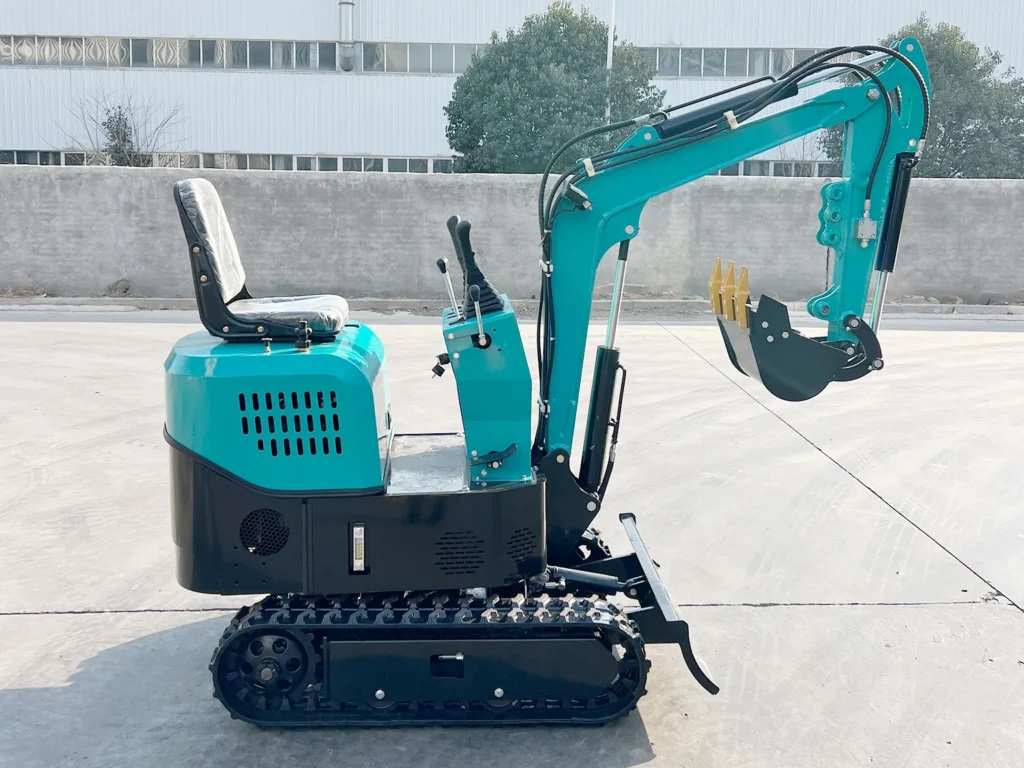
Is it worth buying a mini digger? The answer is yes when the machine has regular work, fits your main job sites, and reduces the cost or delay of repeated rentals. Ownership can also make sense when several attachments allow one machine to complete different jobs.
Buying is not always the better choice. A mini digger requires capital, transport, storage, maintenance, and an operator who understands the machine. Renting may be more practical when the work is occasional, the required machine size changes often, or local rental equipment is easy to obtain.
The decision should not be based only on the purchase price. A buyer should compare the full cost of ownership with the full cost of renting over the same period. The buyer should also consider how quickly the machine can reach a job, what work it can complete, and whether ownership can support more projects.
La société Torchuck Heavy Machinery Co., Ltd. fournit mini-pelles from compact narrow-access machines to larger models for construction, landscaping, farming, rental fleets, and equipment dealers. The current Torchuck range covers several weight classes and supports buckets, augers, breakers, rippers, grapples, rakes, and other attachments.
This guide explains when buying a mini digger makes financial and practical sense, when renting remains the better option, and how to choose a suitable Torchuck machine without relying on unsupported return-on-investment claims.
When Is Buying a Mini Digger Usually Worth It?
Buying a mini digger is more likely to make sense when the machine will have steady work instead of sitting unused for long periods.
A landscaping contractor may use it for drainage, planting, trenching, stump work, grading, and fence installation. A farm may use it to clean ditches, install irrigation, repair tracks, drill post holes, and maintain buildings. A property service company may use it for utility repairs, garden work, and small demolition.
Ownership can also be valuable when rental availability causes delays. A contractor who owns the machine can respond to a new job without waiting for a rental unit, arranging delivery, or returning equipment within a limited period.
The machine may also support small jobs that would not justify a separate rental. A contractor can use an owned excavator for a few hours, move it to another site, and continue working without starting a new rental agreement.
The U.S. Small Business Administration states that buying equipment can be a suitable choice when a business has enough cash or credit and expects to use the asset for a long time. It also notes that leasing or renting may require less money upfront and can allow a business to test equipment before making a longer commitment. Buyers should still confirm local accounting, tax, and finance rules because they vary by country. The SBA’s equipment guidance provides a useful general comparison.
Buying becomes less attractive when the future workload is uncertain. A machine that stays in storage still ties up capital and may continue to create insurance, storage, finance, and maintenance costs.
Compare the Total Cost, Not Only the Purchase Price
The purchase price is only one part of mini digger ownership.
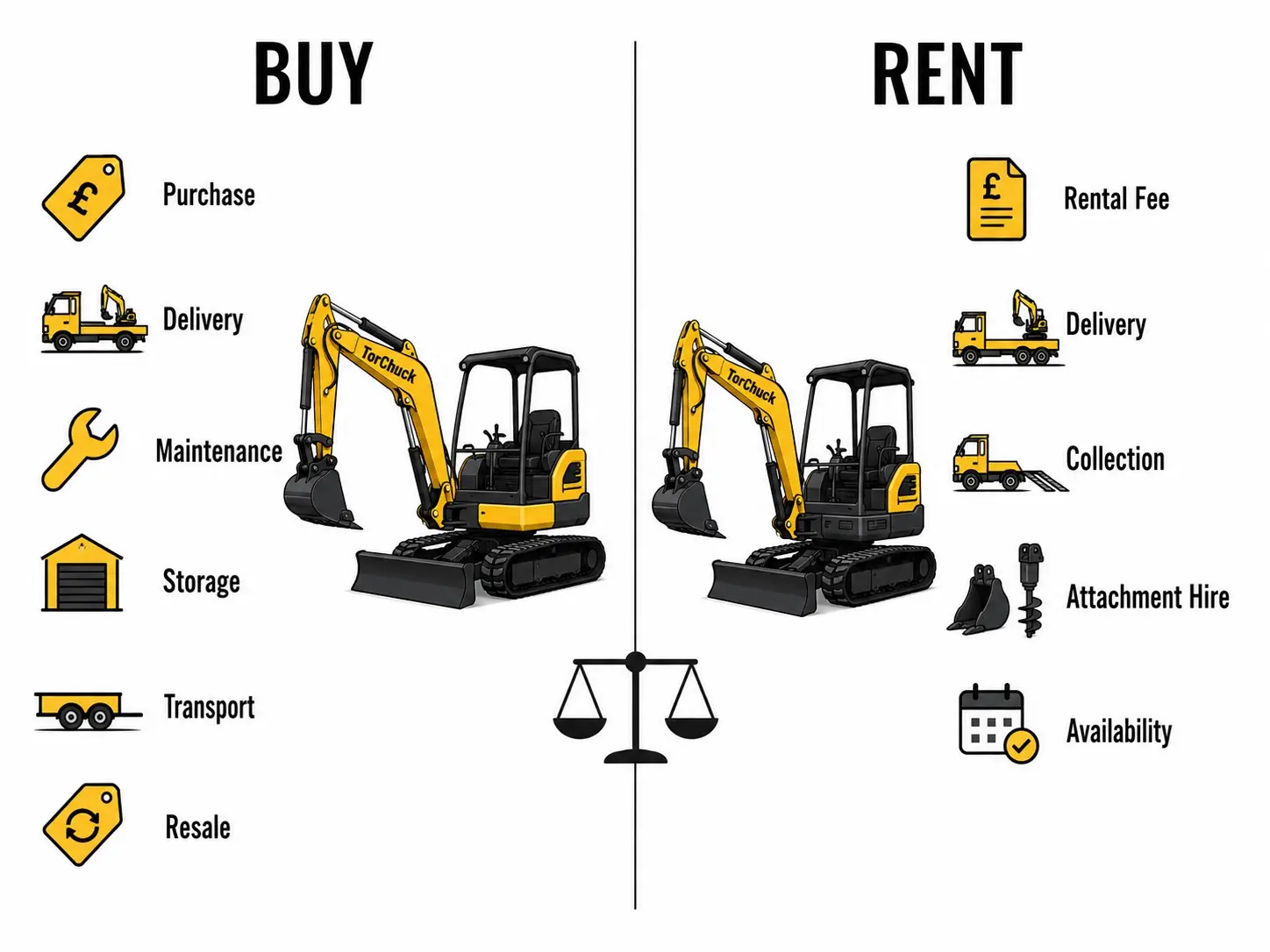
A proper comparison should use the idea of total cost of ownership. This approach includes the direct and indirect costs that appear during the period in which the equipment is owned and used.
For a mini excavator, the calculation may include:
Estimated ownership cost = purchase cost + delivery and import costs + financing + maintenance + insurance + storage + local transport − estimated resale value
The exact items will depend on the buyer and destination. Import duties, taxes, registration, insurance, and road transport rules are not the same in every market.
Rental costs also involve more than the advertised daily or weekly rate. A realistic rental calculation may include delivery, collection, fuel, attachment rental, deposits, overtime charges, damage conditions, and delays caused by unavailable equipment.
The two totals should cover the same period and the same expected work. A one-year ownership estimate should not be compared with only one month of rental costs.
A buyer should also avoid using an unsupported rule such as “buy after a certain number of rental days.” Rental prices, machine prices, finance costs, resale values, and local transport charges vary too much for one break-even number to apply everywhere.
The most useful method is to collect actual quotations. Ask for the delivered cost of the machine, the local rental price, attachment costs, transport charges, and expected maintenance. The buyer can then compare real figures instead of relying on a general online estimate.
How Often Will You Use the Mini Digger?
Machine use should be predictable enough to support the purchase.
Start by reviewing completed and planned projects. Record how often you hired an excavator, how long it stayed on each site, which machine size you selected, and which attachments you used.
Then look at work that you did not accept. A business may lose small trenching, drainage, landscaping, or fence projects because hiring a machine would make the job too expensive or because the required equipment was not available.
These missed opportunities matter, but they should not be treated as guaranteed future income. A business should only include work that matches its real customer base, service area, staff, and sales capacity.
Seasonal use also needs attention. A landscaping company may have a busy spring and summer but little excavation work during winter. A farm may use the machine throughout the year for different maintenance tasks. A rental company may serve many customers but face uneven demand between machine sizes.
The type of use matters as much as the frequency. A machine that operates on several short jobs may create more transport work than one that remains on a long project. The buyer must include this movement in the ownership plan.
A written usage record gives a clearer answer than a general feeling that the machine will be “used often.”
Can One Mini Digger Complete Several Types of Work?
A mini digger becomes more valuable when it replaces more than one single-purpose tool.
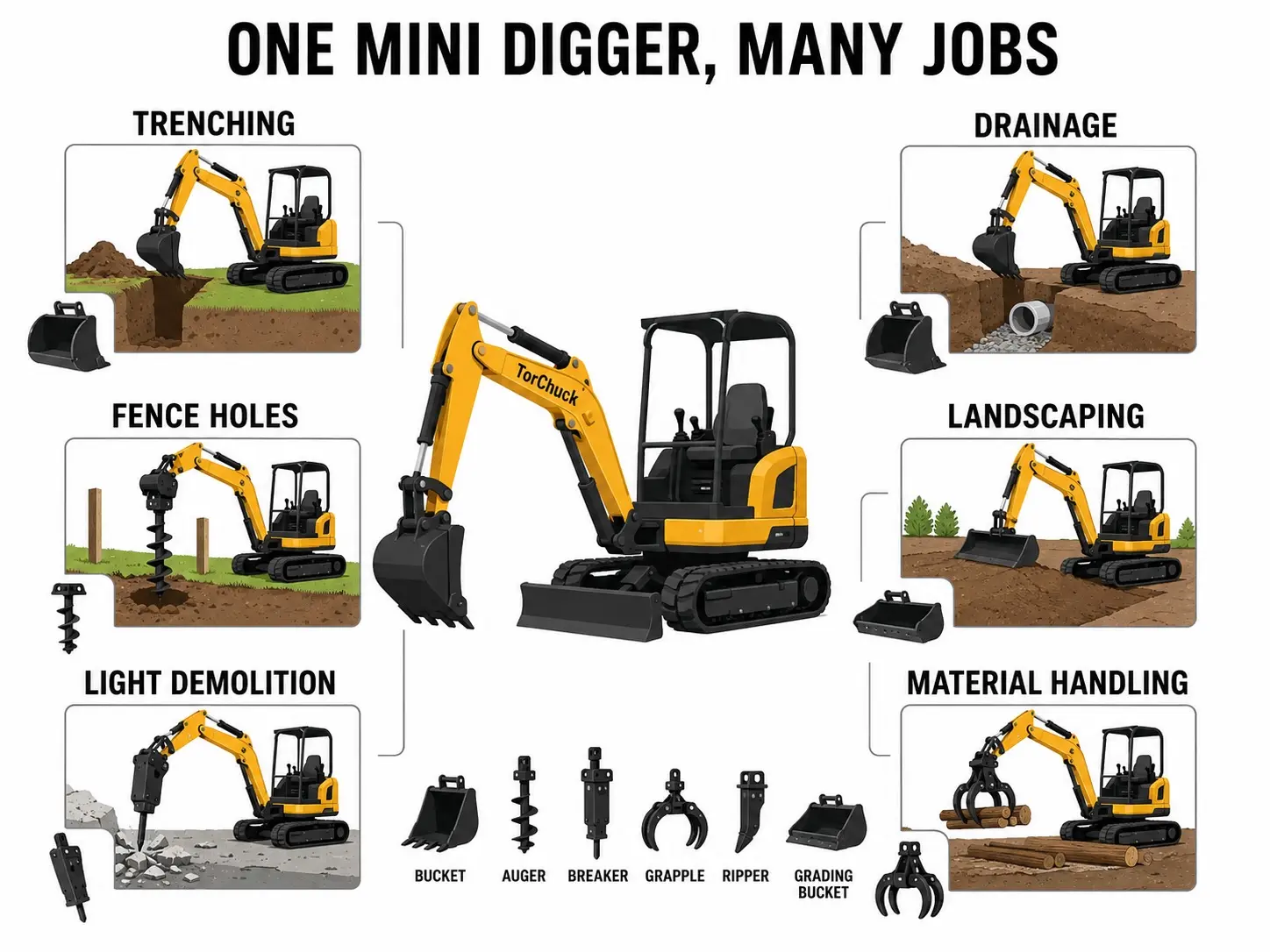
A standard bucket can handle trenching, drainage, planting, ditch cleaning, and general excavation. A narrow bucket can open utility trenches with less soil disturbance. A grading or mud bucket can help with cleaning and finishing.
A hydraulic auger can drill holes for fences, trees, signs, and farm projects. A breaker can handle suitable light demolition and concrete work. A ripper can loosen compacted soil and roots. A grapple or hydraulic thumb can improve material handling.
Torchuck offers a range of mini excavator attachments, while its main mini excavator page lists buckets, hydraulic thumbs, rippers, rakes, augers, breakers, grading buckets, and grapples among the available options. Attachment compatibility must be confirmed for the selected machine, auxiliary hydraulic system, coupler, flow, pressure, and working weight.
A buyer should not order every available attachment. The better approach is to choose tools that match current customer demand.
A fencing contractor may gain more value from an auger and narrow bucket. A landscaper may use several buckets, a ripper, and a grapple. A property maintenance company may need a breaker for occasional demolition. A farm may focus on drainage, ditch cleaning, post holes, and material handling.
Attachments can increase the value of ownership, but they also increase the initial cost, transport weight, storage requirement, and maintenance responsibility. Each attachment should have a clear purpose.
Can You Transport and Store the Machine?
Transport can decide whether mini digger ownership is practical.
The buyer needs a suitable trailer or transport service. The transport plan must account for the operating weight of the machine and the additional weight of the bucket, fuel, spare parts, and attachments.
A compact model may be easier to move between residential or farm projects. A larger machine may provide more digging force and stability, but it will also require more transport capacity.
The buyer should confirm the trailer rating, towing vehicle limits, axle loads, tie-down points, ramps, and local road rules. These requirements vary by country and vehicle class. A machine should not be selected from operating weight alone without checking the full transport setup.
Storage also affects the decision. The machine needs a secure area that protects it from theft, unauthorized use, and unnecessary exposure. The owner may also need room for buckets, an auger, a breaker, filters, hoses, and other parts.
A contractor without secure storage may find that rental remains simpler. A farm, equipment yard, or established workshop may already have suitable space.
Site access creates another practical limit. The machine must fit through gates, lanes, yards, and indoor openings before it can produce any value. The Torchuck 10Q, for example, has a listed total width of 930 mm and is designed for narrow gates, small yards, farms, landscaping, and street repair work.
Buyers who frequently work in restricted spaces should consider overall width, blade width, canopy height, tail swing, and attachment width together.
Are You Ready to Maintain Your Own Equipment?
Rental moves much of the equipment-management responsibility to the rental company. Ownership moves that responsibility to the buyer.
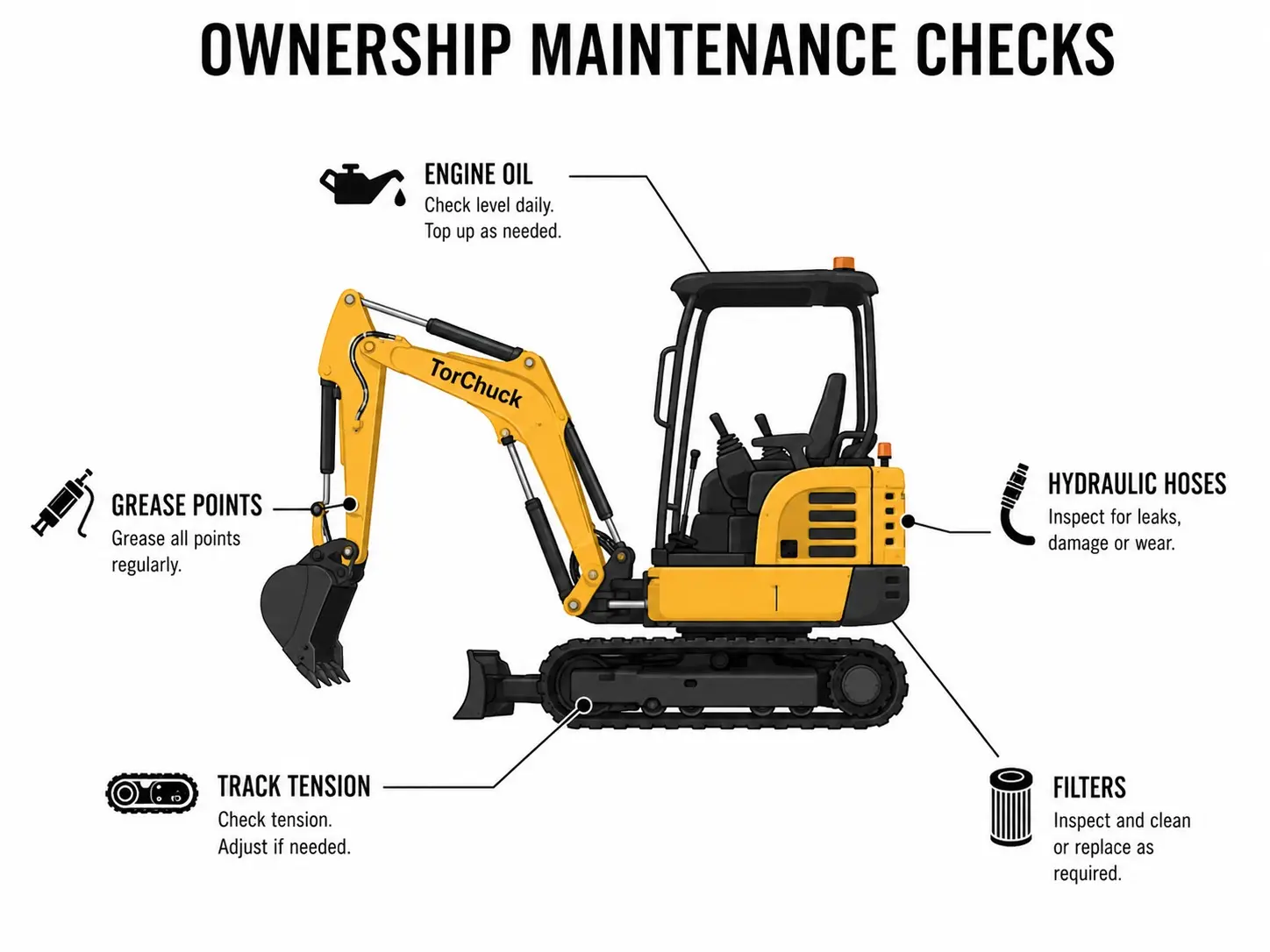
A mini digger needs regular inspection and maintenance. The owner must monitor fluids, filters, grease points, tracks, pins, bushings, hoses, cylinders, electrical connections, and safety components according to the manufacturer’s instructions.
The UK Health and Safety Executive states that effective maintenance can improve equipment reliability and productivity. It also says that work equipment should be kept in efficient working order and that maintenance should follow the manufacturer’s guidance, especially where safety-critical features are involved. Maintenance should be carried out by competent people and with the machine made safe before the work begins. HSE maintenance guidance provides further information.
A buyer does not need to perform every repair personally. Local engine, hydraulic, electrical, or welding specialists may handle more advanced work. However, someone still needs to organize inspections, report faults, order parts, and prevent the machine from working with a known problem.
Before buying, ask whether the supplier can provide an English manual, parts list, service information, common replacement parts, and remote technical guidance.
Torchuck states that it supports overseas customers with manuals, parts supply, export documentation, inspection, and remote assistance. The exact warranty, parts availability, and response arrangements should be confirmed in the written quotation and sales agreement for the selected model.
Ownership is more likely to work well when the buyer has a clear maintenance process. It becomes risky when no one is responsible for daily checks or when damaged equipment continues to operate.
Can Ownership Help a Small Business Take More Work?
A purchased mini digger can become more than an equipment cost. It can become part of the business service.
A landscaping company can offer trenching, drainage, grading, tree planting, and small earthworks without relying on an outside machine for every project. A fencing company can add post-hole drilling and ground preparation. A property service business can respond to small repair and utility jobs.
The main commercial benefit is control. The owner decides when the machine moves, which attachments stay with it, how it is maintained, and when it is available.
That control can shorten preparation time and help the company schedule several small projects. It can also make pricing more consistent because the contractor is not requesting a new rental quotation for every job.
However, ownership does not automatically create profitable work. The business still needs customers, trained operators, transport, accurate estimating, and enough margin to cover the machine’s costs.
A buyer should not justify the purchase with an assumed hourly income unless local job demand and pricing support that assumption.
Equipment dealers and rental companies need a different calculation. A dealer should study local demand by weight class, engine requirements, attachments, and customer type. A rental company should also consider damage risk, operator experience, cleaning, inspection, and turnaround between hires.
When Is Renting a Mini Digger the Better Choice?
Renting is usually more practical for a single short project.
A property owner who only needs to complete one drainage line or garden project may not gain enough future use from ownership. Rental removes the need for long-term storage, resale, and routine equipment management.
Rental may also suit contractors whose required machine size changes from project to project. A very compact excavator may suit one garden, while another project needs greater depth, lifting capacity, or a closed cab.
A buyer should also consider renting when:
- The future workload is unclear.
- Suitable transport is not available.
- Secure storage is difficult.
- The buyer has no maintenance plan.
- Local rental machines are readily available.
- A specialist attachment is needed only once.
- The project requires a machine outside the buyer’s normal size class.
A short rental period can also help a first-time buyer understand controls, access, transport, and attachment needs before ordering a machine.
Renting does not mean buying is a bad idea. It may be part of the decision process. A contractor can rent several sizes, record the actual work, and then purchase the class that appears most often.
Should You Buy a New or Used Mini Digger?
A new mini digger normally provides clearer specifications, supplier support, known operating history, and a written warranty arrangement.
The buyer can also choose the engine, canopy or cab, track type, attachments, color, branding, and other available options before delivery.
A used machine may require less capital, but condition matters more than age alone. The buyer should inspect the engine, hydraulics, tracks, sprockets, rollers, pins, bushings, boom, arm, bucket linkage, electrical system, leaks, and service history.
A low recorded hour figure does not replace a physical inspection. Working conditions, maintenance, storage, and previous repair quality can all affect the machine.
The buyer should also confirm that replacement parts and technical information remain available. An inexpensive used machine may become costly if critical components are difficult to identify or source.
New and used equipment should be compared on total expected cost, not only the initial payment.
Which Torchuck Mini Digger Fits Different Buyers?
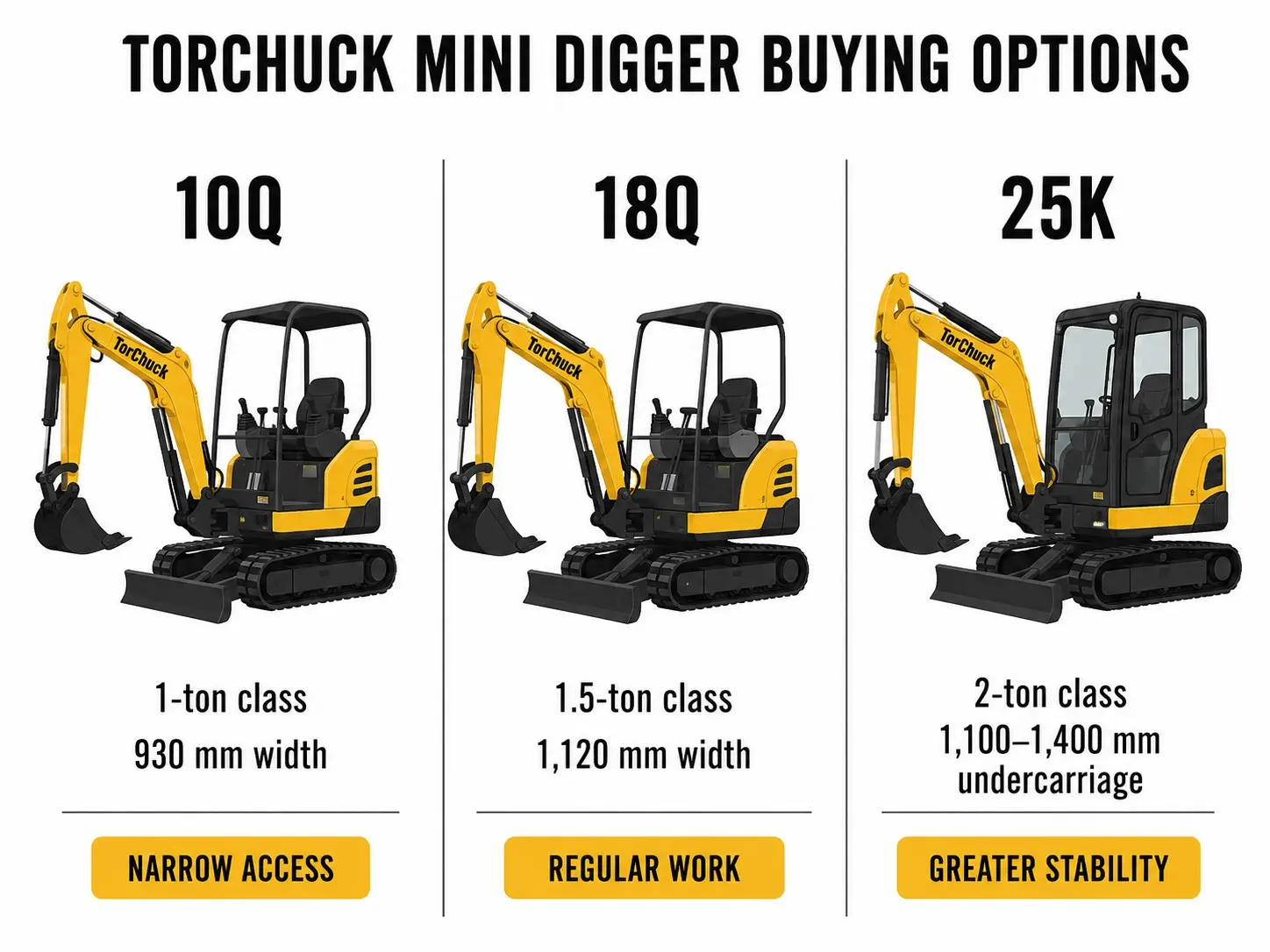
Torchuck offers several mini excavator classes. The right model depends on access, workload, digging requirements, transport, and attachments.
Torchuck 10Q for Narrow Access and Light Regular Work
Le Torchuck 10Q Mini Excavator is a 1-ton-class machine with a listed operating weight of 1,000 kg, total width of 930 mm, maximum digging depth of 1,835 mm, and maximum digging force of 7.2 kN. It supports buckets, augers, breakers, rippers, rakes, and other compatible attachments.
The 10Q is relevant to landscapers, farms, property maintenance businesses, and contractors who frequently work through narrow gates or in small yards.
Its compact size is an advantage when transport and access are more important than maximum digging capacity.
Torchuck 18Q for Broader Contractor Work
Le Torchuck 18Q Mini Excavator is a 1.5-ton-class machine. The current product page lists an operating weight of 1,500 kg, total width of 1,120 mm, maximum digging depth of 2,091 mm, and maximum digging force of 10 kN.
It also supports a quick-coupler interface for augers, rippers, rakes, thumbs, breakers, and other tools.
This class may suit contractors and rental fleets that need more working capacity while keeping the machine relatively compact.
Torchuck 25K for More Demanding Conditions
Le Mini-pelle Torchuck 25K is presented as a compact 2-ton-class machine. Its telescopic undercarriage adjusts from 1,100 mm to 1,400 mm, allowing a narrower access position and a wider working stance.
The page also lists several diesel engine options and support for augers, hammers, grapples, and other attachments.
This type of configuration may suit buyers who need more stability and attachment capacity for regular trenching, drainage, construction, and landscaping.
The largest model is not automatically the best investment. A machine earns its value by fitting the buyer’s common jobs. A lighter unit may work more often because it is easier to transport and access. A larger unit may be more suitable when harder ground, deeper excavation, or heavier attachments are common.
A Practical Buy-or-Rent Decision
The table below does not provide a fixed financial threshold. It shows which conditions normally support each decision.
| Decision Factor | Buying May Make More Sense | Renting May Make More Sense |
|---|---|---|
| Workload | Regular and predictable projects | Occasional or uncertain projects |
| Machine size | Similar size suits most jobs | Required size changes often |
| Pièces jointes | Several tools will be used regularly | Specialist tool needed once |
| Availability | Rental delays affect scheduling | Local machines are readily available |
| Transport | Suitable trailer or service is available | Transport is difficult or expensive |
| Storage | Secure space is available | No suitable long-term storage |
| Maintenance | A clear inspection and service plan exists | Buyer does not want maintenance responsibility |
| Business plan | Machine supports established services | Future customer demand is untested |
A buyer does not need every point in the left column before purchasing. However, several strong buying signals should exist at the same time.
When most conditions fall into the renting column, ownership may create more cost and responsibility than value.
Foire aux questions
Is a Mini Excavator Worth It for a Small Business?
A mini excavator can be worth buying for a small business that has regular excavation, landscaping, drainage, farm, fencing, or property-maintenance work.
The company should compare total ownership cost with real rental quotations and confirm transport, storage, maintenance, and customer demand before ordering.
Is It Better to Buy or Rent a Mini Digger?
Buying is usually better suited to regular, predictable work. Renting is usually better suited to occasional projects, uncertain demand, or jobs that require different machine sizes.
The right decision depends on local prices and working conditions. No single usage threshold applies to every buyer.
Can a Mini Digger Make Money?
A mini digger can support paid services, but the machine does not guarantee income.
Profit depends on customer demand, job pricing, operating cost, transport, maintenance, operator skill, and machine utilization. Buyers should use their own business records instead of relying on promised earnings.
What Costs Should I Check Before Buying?
Check the machine price, delivery, import costs, local transport, financing, insurance, storage, maintenance, parts, attachments, and possible resale value.
You should compare these costs with rental charges over the same expected period.
Is a 1-Ton Mini Digger Enough?
A 1-ton machine can suit narrow-access landscaping, garden work, drainage, irrigation, fence installation, farm maintenance, and other light jobs.
The required digging depth, ground condition, lifting need, access, and attachments must still be checked.
Should a First-Time Buyer Start with a Small Machine?
A small machine may be easier to transport and use on restricted sites, but the buyer should not choose it only because it is cheaper.
The machine must have enough capacity for the main work. A model that is too small may work slowly or fail to handle the planned attachments.
What Information Should I Send to Torchuck?
Send the main job types, expected working frequency, required digging depth, site access, transport limits, destination country, preferred engine, canopy or cab requirement, and attachment list.
Torchuck can use this information to compare suitable models and prepare a configuration and quotation.
Conclusion
A mini digger is worth buying when it has regular work, fits the buyer’s job sites, and provides more long-term value than repeated rental.
The decision should include total ownership cost, not only the machine price. Transport, storage, maintenance, attachments, finance, and resale value all affect the result.
Ownership can give a contractor more control over scheduling and allow one machine to complete several types of work. Renting remains the more practical choice for occasional projects, uncertain demand, or buyers without transport, storage, or maintenance support.
Torchuck Heavy Machinery Co., Ltd. offers mini excavators for narrow-access work, landscaping, construction, farming, equipment rental, and dealer markets. Send Torchuck your expected workload, job conditions, transport limits, destination, and attachment requirements. The team can recommend a suitable mini digger configuration and provide a clear quotation based on your actual needs.