La largeur de passage d'une mini-pelle varie généralement entre environ 700 mm et 1 500 mm, en fonction de la catégorie de la machine et de la conception de son châssis. Un modèle compact d'une largeur comprise entre environ 700 mm et 1 000 mm peut franchir de nombreux portails de jardin et entrées d'arrière-cour. La compatibilité exacte dépend de la largeur libre de l'ouverture et de la partie la plus large de la machine.
Une micro-pelle peut mesurer moins de 800 mm de large, ce qui lui permet d'accéder à des espaces très exigus. Une mini-pelle de 1 tonne mesure souvent entre 900 mm et 1 000 mm de large. Elle offre une meilleure capacité d'excavation tout en restant suffisamment compacte pour franchir de nombreuses entrées de maisons. La plupart des machines de 1,5 et 2 tonnes nécessitent un portail plus large.
Le poids en ordre de marche ne suffit pas à lui seul à déterminer si une machine pourra passer. Deux mini-pelles appartenant à la même catégorie de poids peuvent présenter des dimensions différentes. La lame de remblayage peut être plus large que les chenilles. Les rétroviseurs, les commandes, les flexibles hydrauliques et les équipements auxiliaires peuvent également nécessiter un dégagement supplémentaire.
La société Torchuck Heavy Machinery Co., Ltd. fournit mini-pelles pour les travaux dans des espaces restreints, l'aménagement paysager, le creusement de tranchées, l'agriculture, les flottes de location et les petits chantiers de construction. Selon le modèle, les acheteurs peuvent opter pour des carrosseries compactes, des châssis extensibles, un bras pivotant, différents systèmes de chenilles et plusieurs options d'équipements.
Ce guide explique comment mesurer une entrée, déterminer la largeur réelle de la machine et choisir une mini-pelle Torchuck adaptée à un chantier aux accès restreints.
Quelle mini-pelle peut passer par un portail ?
Une mini-pelle étroite peut passer par un portail lorsque sa largeur extérieure maximale est inférieure à la largeur libre de passage.
La largeur du portillon doit être mesurée à son point le plus étroit. L'appareil nécessite également un peu d'espace libre de chaque côté. Un modèle dont la largeur n'est que de quelques millimètres inférieure à celle de l'ouverture peut être conforme aux spécifications, mais il peut néanmoins s'avérer difficile à faire passer en toute sécurité.
Pour les accès très étroits, une micro-pelle d'une largeur comprise entre environ 700 mm et 800 mm constitue souvent le meilleur choix de départ. Les engins de cette catégorie sont couramment utilisés dans les jardins, les petites cours, les chantiers de rénovation et les espaces étroits entre les bâtiments.
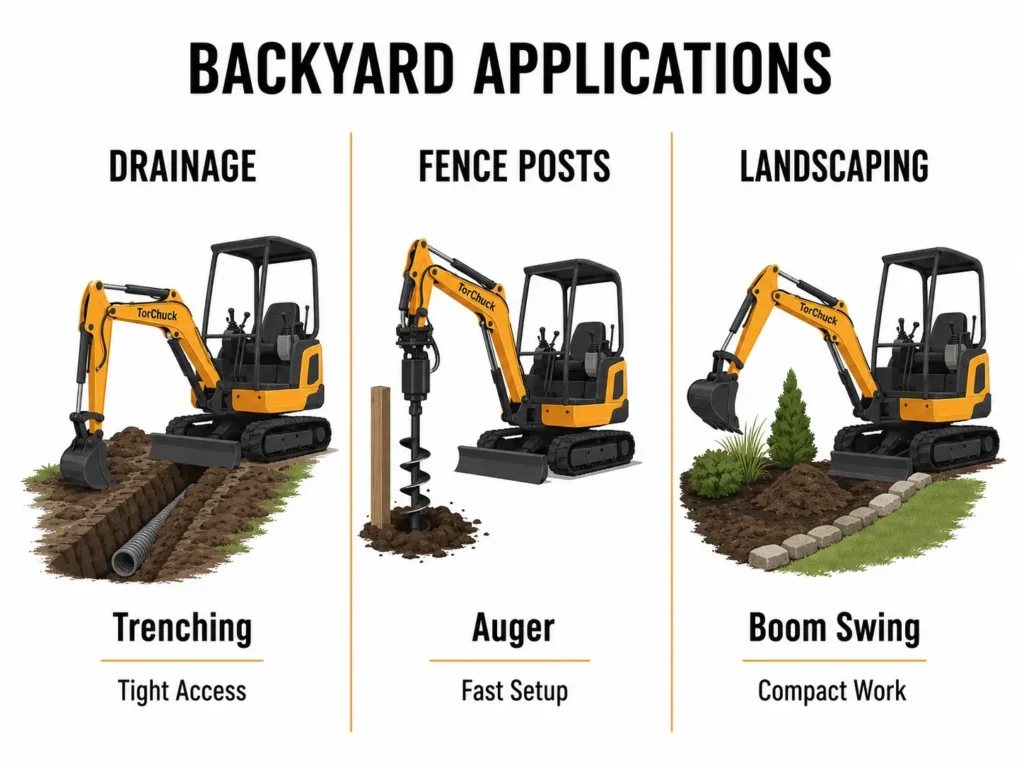
Une mini-pelle de 1 tonne, d'une largeur comprise entre environ 900 mm et 1 000 mm, permet d'effectuer des travaux plus exigeants tout en restant compacte. Ce format convient souvent aux travaux de drainage résidentiel, d'aménagement paysager, de pose de clôtures, d'irrigation et de petits chantiers de construction.
Le Torchuck Mini-pelle 10Q Sa largeur totale indiquée est de 930 mm. Il est conçu pour les portails étroits, les petites cours, les travaux agricoles, l'aménagement paysager et la réfection des voiries. La largeur de passage libre doit être supérieure à 930 mm. L'utilisateur doit également prévoir un espace suffisant de chaque côté pour permettre un déplacement contrôlé.
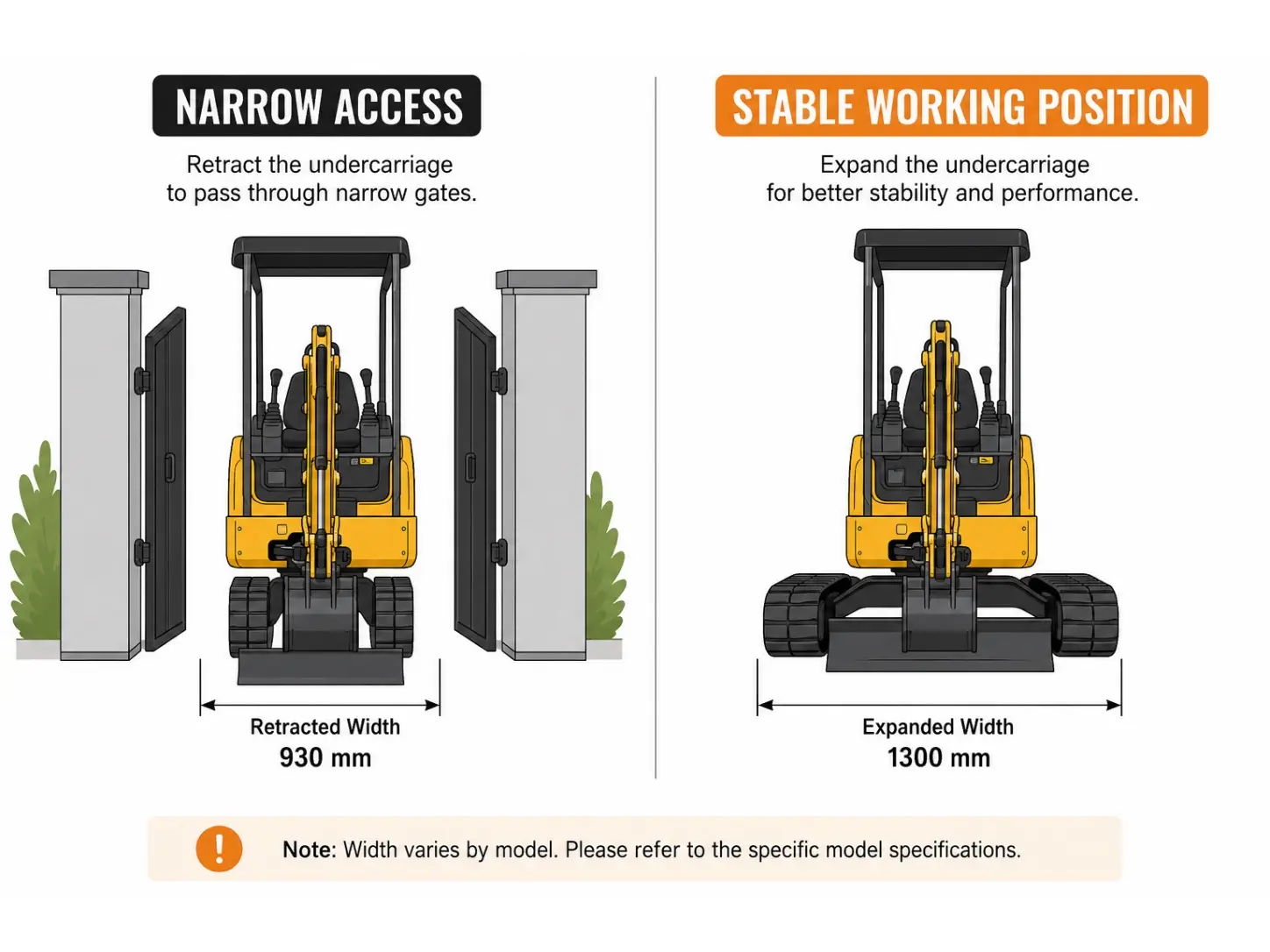
Certaines mini-pelles sont équipées d'un train de roulement extensible. L'opérateur rétracte les chenilles avant d'entrer sur le chantier et les déploie une fois arrivé sur la zone de travail. Cette conception permet de franchir des passages étroits sans renoncer à la largeur de base nécessaire à la stabilité lors du creusement.
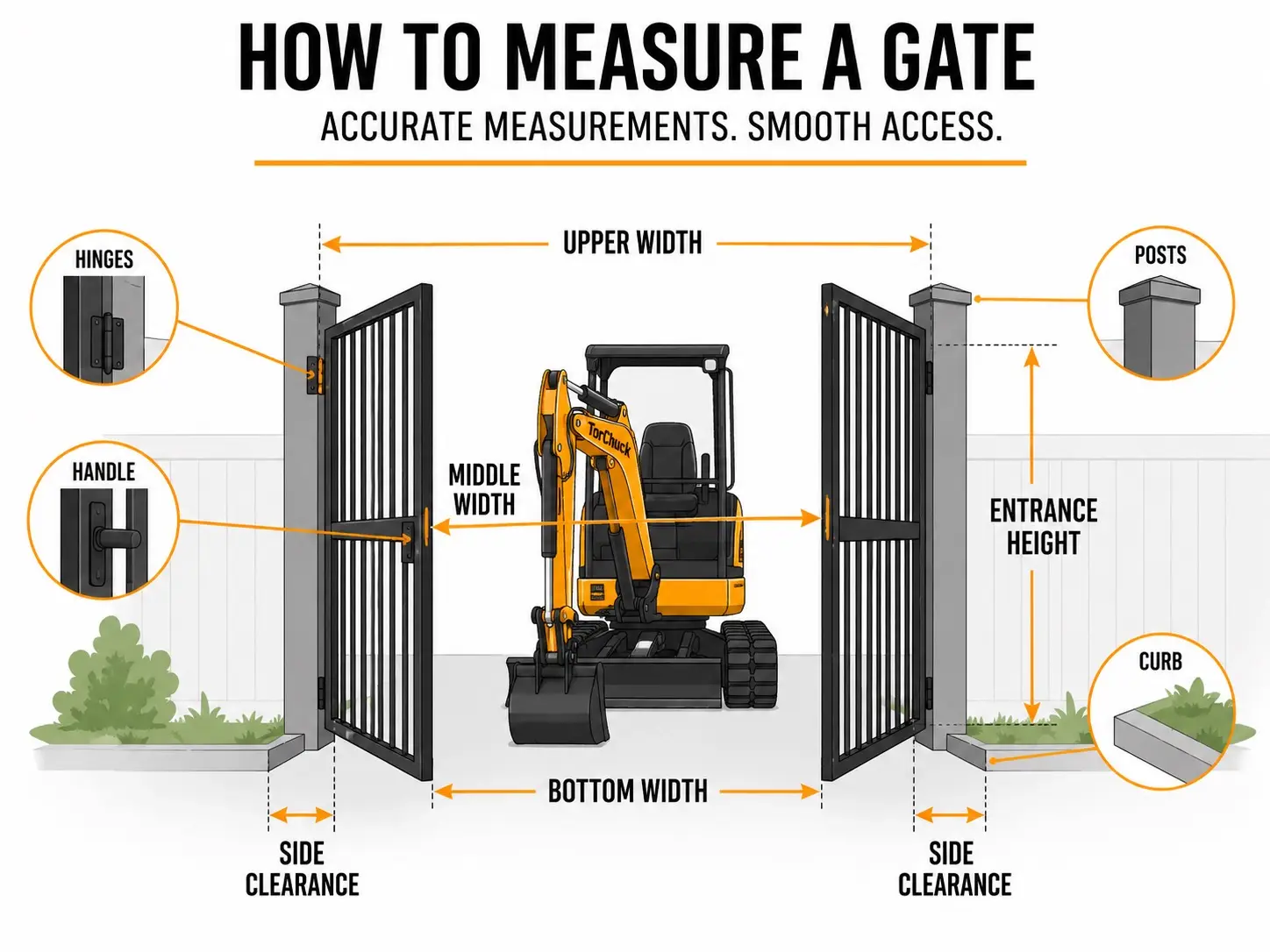
Commencez par mesurer l'ouverture libre de la porte
La largeur indiquée d'un portillon peut ne pas correspondre à son ouverture utile réelle. Les charnières, les montants, les poignées, les loquets et les murs irréguliers peuvent tous réduire l'espace disponible.
Ouvrez complètement le portail avant de procéder à toute mesure. Mesurez la distance entre les deux points fixes les plus proches. Ne mesurez pas du bord extérieur d'un poteau au bord extérieur de l'autre, car la machine ne peut pas exploiter cette distance dans son intégralité.
Prenez les mesures près du bas, du milieu et du haut de l'ouverture. La mesure du bas doit tenir compte des bordures, des pierres, des racines apparentes et de la hauteur libre par rapport aux rails. La mesure du milieu doit prendre en compte les charnières, les loquets, les poignées et les bords du mur. La mesure du haut doit inclure l'auvent, les rétroviseurs, les feux, les branches, les câbles ou le cadre d'un portail.
Vous devez également inspecter le sol. Une pente peut entraîner une inclinaison du haut de la machine vers un côté. Une bordure surélevée peut faire dévier les chenilles du centre de l'ouverture. Un sol meuble peut entraîner l'enfoncement d'une chenille. Chacune de ces conditions peut réduire la garde au sol effective dont dispose l'opérateur.
| Mesure | Ce qu'il faut vérifier |
|---|---|
| Largeur à la base | Poteaux, bordures, pierres, racines et dégagement de la voie |
| Largeur moyenne | Charnières, loquets, poignées et bords muraux |
| Largeur supérieure | Auvent, rétroviseurs, feux et structures en hauteur |
| Hauteur de l'entrée | Cadre du portail, toit, branches et câbles |
| État du sol | Pente, sol meuble, marches et revêtement irrégulier |
| L'espace après la porte | Marge de manœuvre et espace nécessaire pour la flèche et la pelle |
Prévoyez une marge suffisante de chaque côté. Un espace supplémentaire permet à l'opérateur d'avoir un meilleur contrôle et réduit le risque d'endommager la machine, le portail ou le mur adjacent.
Quelques centimètres peuvent faire la différence pour que la machine s'insère sans encombre. Des mesures précises sont plus utiles qu'une estimation à l'œil nu ou qu'une dimension de passage tirée d'un ancien plan.
Vérifiez la partie la plus large de la mini-pelle
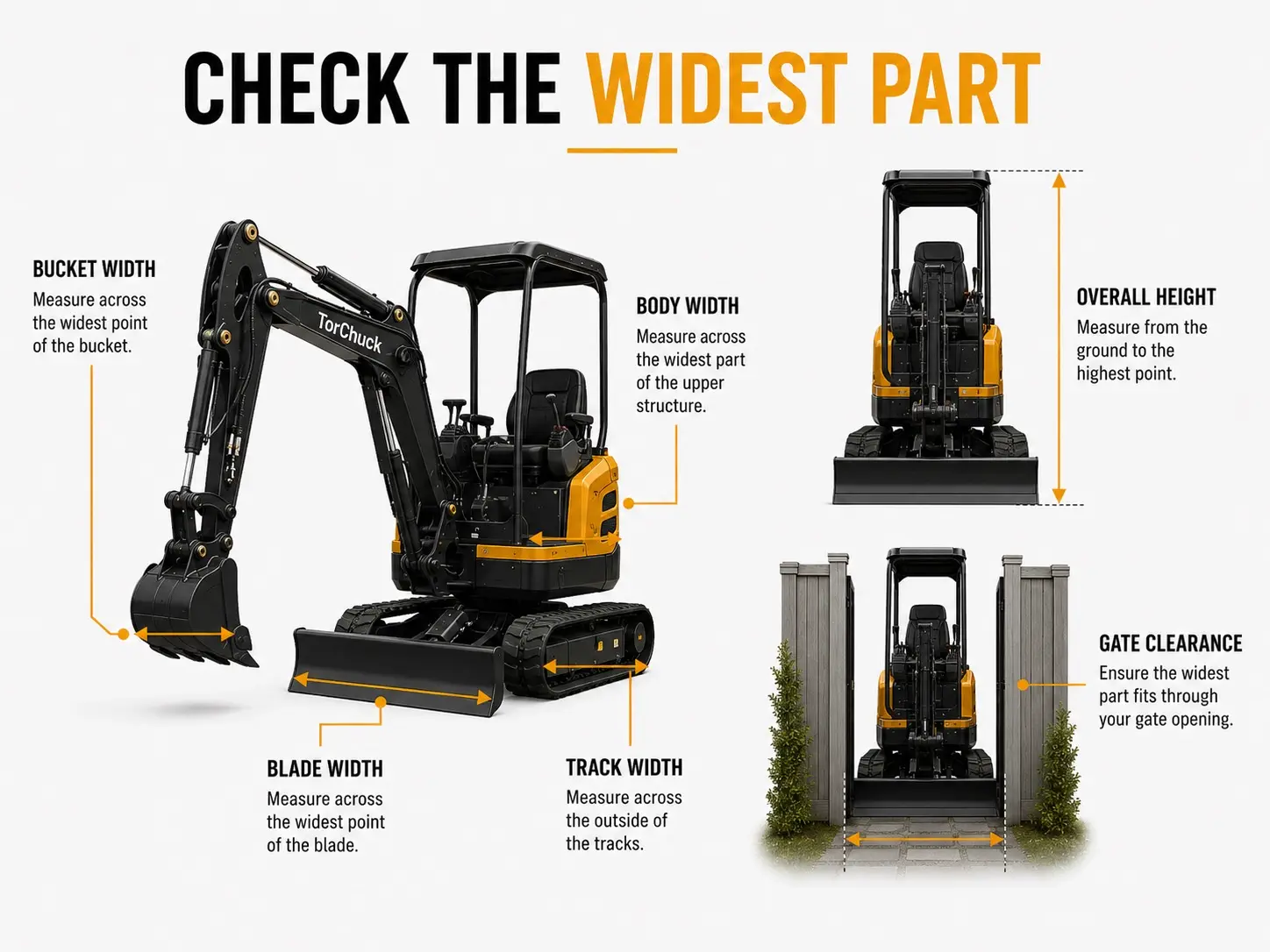
La largeur de voie ne correspond pas toujours à la largeur hors tout de la machine.
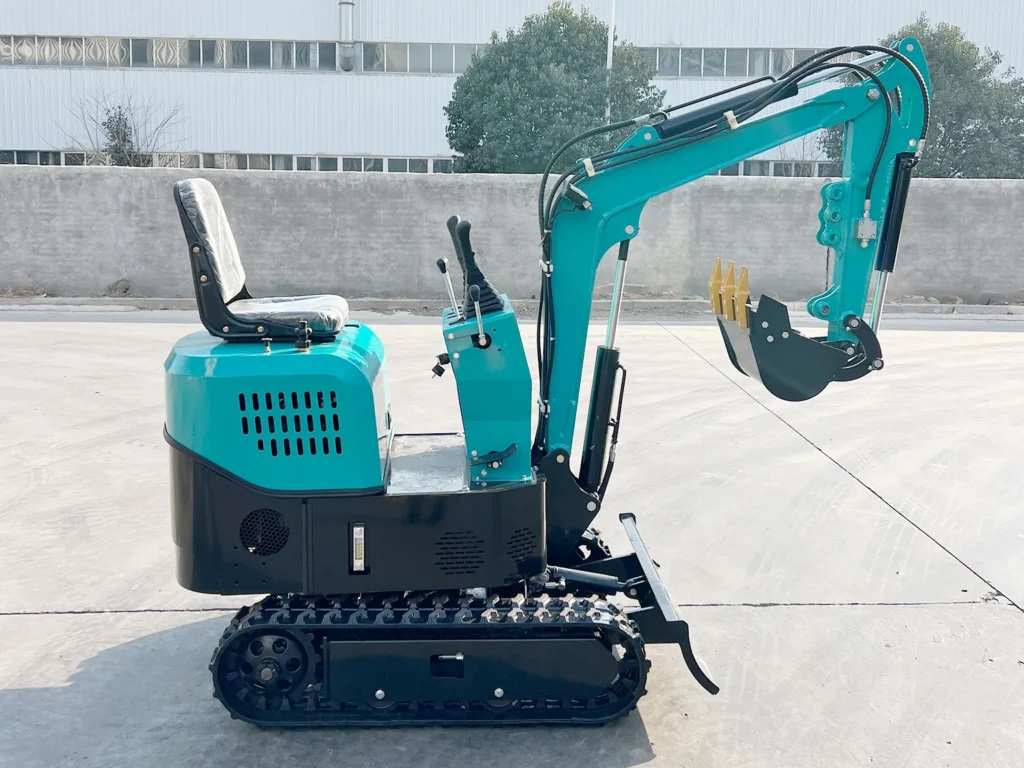
Un pelleteuse se compose d'un châssis, d'une structure supérieure pivotante, d'une flèche, d'un bras et d'un godet. Plusieurs éléments de cette structure peuvent avoir une incidence sur la hauteur libre requise au niveau d'une entrée étroite.
Sur certaines mini-pelles, la lame de remblayage est l'élément le plus large. Certaines lames se replient ou se rétractent, tandis que d'autres restent fixes. La structure supérieure peut également dépasser des chenilles. Un contrepoids, un levier de commande, un panneau latéral, un rétroviseur ou un composant hydraulique peuvent venir augmenter la largeur totale.
Les accessoires posent un autre problème potentiel. Un godet d'excavation standard peut passer sans difficulté par l'ouverture, mais un godet de nivellement ou un godet à boue peut être nettement plus large que le châssis. Une tarière, un grappin ou une pince hydraulique peuvent également nécessiter davantage d'espace autour du bras.
Avant de passer commande, vérifiez la largeur hors tout de la machine et demandez si cette mesure est calculée par rapport aux chenilles, à la lame ou à la partie supérieure de la machine. Vous devez également vérifier la largeur des chenilles en position rétractée et déployée, la hauteur hors tout, la largeur du godet et le rayon de rotation arrière.
La fiche technique définitive doit servir de référence principale. Il est toutefois utile de vérifier si la lame est repliable et si un accessoire de grande envergure peut être démonté avant que la machine n'arrive sur le chantier.
Largeurs courantes des mini-pelles pour le passage des portails
Les exigences en matière de largeur de passage pour les mini-pelles varient selon le modèle et la configuration. Les fourchettes indiquées ci-dessous constituent un point de départ pratique.
| Cours sur les mini-pelles | Common Width Range | Gate Access |
| Micro excavator | About 700–800 mm | Suitable for very narrow garden gates and tight passages |
| Compact 1-ton model | About 850–1,000 mm | Suitable for many residential gates and backyard entrances |
| 1.2–1.5 ton model | About 900–1,200 mm | May fit wider single gates or retractable-track applications |
| 1.8–2.5 ton model | About 1,000–1,500 mm | Usually needs a wide gate, double gate, or open access |
| Larger compact model | More than 1,500 mm | Usually needs construction access rather than a garden gate |
These figures are general ranges, not fixed rules. Some heavier models use a narrow retractable chassis. Some lighter machines have a wide fixed blade.
Always compare the exact machine specification with the exact entrance. Another machine of a similar weight passing through a nearby gate does not prove that your chosen model will also fit.
Our guide to the 0.8 vs 1.5 vs 2 ton mini excavator explains how different weight classes affect access, digging capacity, transport, and common applications.
Why an Expandable Undercarriage Helps
An expandable undercarriage allows the operator to change the distance between the tracks.
The tracks retract when the machine needs to pass through a narrow entrance. Once the excavator reaches the work area, the operator expands them again. The wider position creates a larger support base and improves stability.
This feature is useful for backyard landscaping, residential drainage, work beside buildings, garden wall construction, narrow farm paths, and rental fleets that serve many types of job sites.
The retracted position is mainly designed for access. It may not provide the best working stance when the boom is extended or operating to the side. The tracks should normally be expanded before regular digging when the site provides enough room.
The blade design must also match the changing track width. Some machines use folding blade sections that move inward for access and outward during work. Without this feature, the blade may remain wider than the retracted tracks.
Torchuck offers mini excavator configurations with extendable tracks and boom swing. The available features depend on the selected model and final specification. Buyers should confirm both the narrow access width and expanded working width before ordering.
Why Boom Swing Matters in a Backyard
Passing through the gate only solves the first access problem. The machine still needs enough room to work after it enters the yard.
A standard excavator boom works mainly along the center line of the machine. A boom swing system allows the boom to move left or right. This movement helps the operator dig beside a fence, wall, foundation, or garden structure without placing the whole machine directly in front of the trench.
Boom swing also reduces unnecessary repositioning. This advantage matters in a small yard because the operator may not have enough room to turn the tracks several times.
Tail swing deserves the same attention. The rear of the upper structure moves when the machine rotates. A large counterweight may strike a wall or fence. A short-tail or zero-tail design needs less space behind the excavator, but it still requires a clear working area.
Machine width, boom swing, tail swing, and working radius should be considered together. A mini excavator that passes through the entrance may still be unsuitable if it cannot rotate or position the bucket inside the site.
Can a Mini Excavator Fit Through a House?
Some micro excavators are narrow enough to pass through a large doorway or building opening. Width, however, is only one part of the assessment.
The doorway must provide enough width and height. The contractor also needs to inspect the floor, steps, internal corners, wall protection, and available turning space.
Machine weight can damage tiles, wooden floors, and weak concrete. Rubber tracks may reduce surface marks, but they do not reduce the total load placed on the floor. Protective mats or structural support may still be necessary.
Fuel-powered equipment creates a more serious risk. The official NIOSH guidance on carbon monoxide warns against operating gasoline-powered engines inside buildings or partly enclosed areas unless the engine can remain outside and away from air intakes. Exhaust gases can build up even when the area appears to have some ventilation.
An electric mini excavator may be more suitable for certain indoor projects. The contractor must still assess floor loading, visibility, noise, ventilation, emergency access, and local safety requirements.
A machine that fits through a doorway is not automatically safe or practical to operate inside the building.
What Ground Conditions Can Block the Machine?
A gate may be wide enough, but poor ground conditions can still prevent the mini excavator from entering.
A raised threshold can catch a low-clearance undercarriage. A steep slope may cause the upper body to lean toward a gate post. Soft soil can make one track sink, while wet paving may reduce traction.
Inspect the complete access route before moving the machine. A temporary ramp may be needed at a step or threshold. Steel plates, timber mats, gravel, or ground protection mats can create a more stable path over weak or finished surfaces.
The access route must support the weight of the mini excavator. It may also need to support a trailer, lifting device, or other transport equipment used during delivery.
The operator should keep the blade and bucket low while moving through a restricted opening. Slow travel gives the operator more time to correct the machine position. A trained spotter can watch the tracks, canopy, blade, and counterweight from outside the cab.
The access plan should also include a clear exit. The machine must be able to leave after the project is complete, even if soil, pipes, landscaping materials, or other equipment have been placed near the entrance.
Which Mini Excavator Size Is Best for Backyard Work?
The best size depends on both the entrance and the work that the machine needs to complete.
Micro Excavator for Very Narrow Access
A micro excavator is often the best option when entrance width is the main restriction. It can work in small gardens, narrow paths, renovation areas, and gaps between buildings.
Its compact size and lower transport weight make it easier to move between residential job sites. It can handle shallow drainage, small planting holes, light demolition, and other limited excavation work.
The trade-off is lower digging force, lifting capacity, reach, and bucket volume. Hard soil or larger excavation projects may take more time. A very small machine may fit the site but still lack the power needed for the main task.
One-Ton Mini Excavator for Balanced Performance
A 1-ton mini excavator provides a practical balance between access and productivity. It can handle garden drainage, irrigation, cable trenches, tree planting, fence work, and light construction.
The Torchuck 10Q has a total width of 930 mm. Its compact body suits narrow gates, small yards, and restricted streets. It can also work with buckets, augers, breakers, rippers, and rakes.
This class is popular with landscapers, small contractors, farms, and rental companies because one machine can complete several common jobs without requiring a large transport vehicle.
Larger Model for More Demanding Work
A 1.5-ton to 2.5-ton mini excavator provides more digging force, stability, reach, and attachment capacity.
The extra performance comes with a wider body and a larger turning area. The customer may need a double gate, removable fence section, or temporary construction entrance.
A larger model may be the better choice for deep drainage, compacted clay, stump removal, foundation preparation, and regular contractor use. Buyers who need more depth can also review our guide to mini excavator maximum digging depth.
The correct machine should balance access with working capacity. Choosing the smallest model can reduce productivity if the job needs more power. Choosing a machine that is too large may create an access problem before work even begins.
Do Attachments Change the Required Gate Width?
Attachments can change the overall width, length, and balance of the mini excavator.
A standard digging bucket may pass through the entrance without difficulty. A grading bucket or mud bucket can be much wider than the tracks. Augers, grapples, hydraulic thumbs, and breakers may also need more space around the arm.
A wide attachment can be transported through the gate separately and installed inside the work area. A quick hitch makes this process faster, especially when the operator needs to change between a digging bucket, auger, ripper, or grading tool.
Torchuck supplies different mini excavator attachments, including digging buckets, trenching buckets, grading buckets, hydraulic breakers, augers, rippers, grapples, rakes, and quick hitches.
Every attachment must match the machine weight and hydraulic system. An oversized tool can reduce stability and place too much load on a small excavator.
Tell the supplier which attachments you plan to use and how they will enter the site. The supplier can then confirm compatibility, hydraulic flow, machine balance, and transport dimensions.
Seven Checks Before You Order a Narrow-Access Mini Excavator
Start with the entrance itself. Measure the narrowest clear opening between fixed points, not the distance between the outside edges of the posts. Include the hinges, handles, latches, wall edges, and any curb near the ground. Measure the height as well. The canopy or cab must pass below the gate frame, roof, branches, cables, or other overhead limits.
Next, compare these measurements with the full machine dimensions. Ask for the overall width rather than relying on track width. Confirm the dozer blade width because the blade may be the widest part of the machine. You should also check whether the blade folds and whether the undercarriage can retract.
A machine with expandable tracks may enter in its narrow position, but it still needs enough space inside the site to expand before normal digging begins. Check the width of the working area as well as the width of the entrance.
The ground and route also need attention. Look for slopes, thresholds, soft soil, paving edges, and sharp turns. The machine must be able to travel from the gate to the work area without leaning toward a wall or becoming stuck.
Check the available turning space after the gate. The excavator needs room to lower the boom, rotate the upper structure, use the blade, and position the bucket. A model may fit through the gate but still be too large to work inside the yard.
Attachments should be included in the access plan. A wide bucket, auger, grapple, or breaker may need to enter separately. You should confirm whether the attachment can be removed and reinstalled easily at the work site.
The final check is transport. The mini excavator may fit through the gate, but its operating weight and attachments must still match the trailer and towing vehicle. These checks reduce the risk of ordering a machine that reaches the site but cannot enter or work effectively.
What Should Equipment Dealers Ask Their Customers?
A dealer should ask more than, “What tonnage do you need?” Site conditions may be just as important as machine weight.
The dealer should ask for the gate width and height, the work area behind the entrance, the required digging depth, the soil condition, and the planned attachments. Photos of the entrance and site can reveal slopes, walls, curbs, and turning limits that measurements do not fully explain.
The dealer should also ask how the customer will transport the machine. A narrow mini excavator may fit through the gate but still exceed the trailer capacity or towing limit. The buyer should consider the weight of the machine, bucket, attachments, fuel, and spare parts together.
These questions lead to a more accurate recommendation and reduce the risk of returns, complaints, and incorrect model selection. Rental companies can use the same process because narrow-access machines may serve customers with very different job sites.
Why Choose a Torchuck Mini Excavator for Narrow Access?
Torchuck Heavy Machinery Co., Ltd. supplies compact construction machinery to contractors, dealers, rental companies, farms, and property service businesses around the world.
The Torchuck range includes several mini excavator weight classes. Depending on the selected model, available configurations may include compact bodies, expandable tracks, boom swing, rubber tracks, quick hitches, different engine options, and multiple attachments.
The Torchuck team can compare the entrance dimensions with the machine specifications. We also consider digging depth, soil conditions, transport limits, attachment requirements, and the work that the machine needs to complete.
Our support continues after the model has been selected. Torchuck can confirm the final configuration, prepare OEM colors and branding, match the machine with suitable attachments, arrange export packing and shipping documents, and provide spare parts and remote technical assistance after delivery.
Our goal is not simply to offer the smallest machine. We aim to supply a mini excavator that can enter the site and still complete the required work efficiently.
When requesting a quotation, send the clear gate width, gate height, site photos, job type, required digging depth, destination country, and preferred attachments. These details allow Torchuck to provide a more accurate recommendation, configuration, and shipping plan.
Foire aux questions
What Width Mini Excavator Can Fit Through a Garden Gate?
A mini excavator can fit through a garden gate when its full width is smaller than the clear opening. Micro excavators are often about 700 mm to 800 mm wide. Many 1-ton models are about 900 mm to 1,000 mm wide. Always check the exact dimensions of the selected model.
Can a 1-Ton Mini Excavator Fit Through a Gate?
Many 1-ton mini excavators can pass through a wide garden gate. The Torchuck 10Q has a listed total width of 930 mm. The opening must provide more than 930 mm of usable space, plus enough side clearance for safe movement.
Is Track Width the Same as Machine Width?
No. Track width may be smaller than the overall machine width. The blade, upper body, hoses, mirrors, controls, or other components may form the widest point.
Can the Tracks Become Narrower?
Some mini excavators have an expandable undercarriage. The operator can retract the tracks for access and expand them again for work. The available width range depends on the model.
Can a Mini Excavator Go Through a Doorway?
Some micro excavators can pass through large doorways. The contractor must also check entrance height, floor loading, turning space, ventilation, and exhaust safety. A fuel-powered machine should not operate in an enclosed area without a suitable safety system.
Does a Narrow Mini Excavator Have Less Digging Power?
A narrow machine is often smaller and lighter, so it may provide less digging force than a larger model. Width alone does not determine performance. Engine power, hydraulic output, operating weight, arm design, and bucket size also matter.
Can a Mini Excavator Remove Tree Stumps After Passing Through a Gate?
A mini excavator can remove some small and medium stumps. The result depends on machine size, soil conditions, root structure, bucket type, and ripper use. A very small model may need more time and may not be suitable for a large stump.
How Should I Send Gate Measurements to Torchuck?
Send the clear width, clear height, entrance photos, ground conditions, and available turning space. Include the required work, digging depth, and attachment list. Torchuck can then compare the site with suitable machine dimensions.
Conclusion
Mini excavator gate width is the first specification to check when a machine must enter a garden, backyard, or narrow residential site.
A micro or 1-ton mini excavator is usually the best starting point for narrow gate access. Machines between about 700 mm and 1,000 mm wide can enter many gardens, yards, and residential job sites.
Gate width is not the only factor. The blade, upper body, canopy height, bucket, ground conditions, turning space, and working position also affect access.
An expandable undercarriage allows the machine to pass through a narrow opening and then work from a wider stance. Boom swing and a compact tail can also improve performance near fences and walls.
Torchuck Heavy Machinery Co., Ltd. can help you choose a mini excavator based on the actual entrance and job requirements. Send us your gate dimensions, site photos, required digging depth, destination, and attachment list. Torchuck will recommend a suitable narrow-access model and provide a clear quotation.