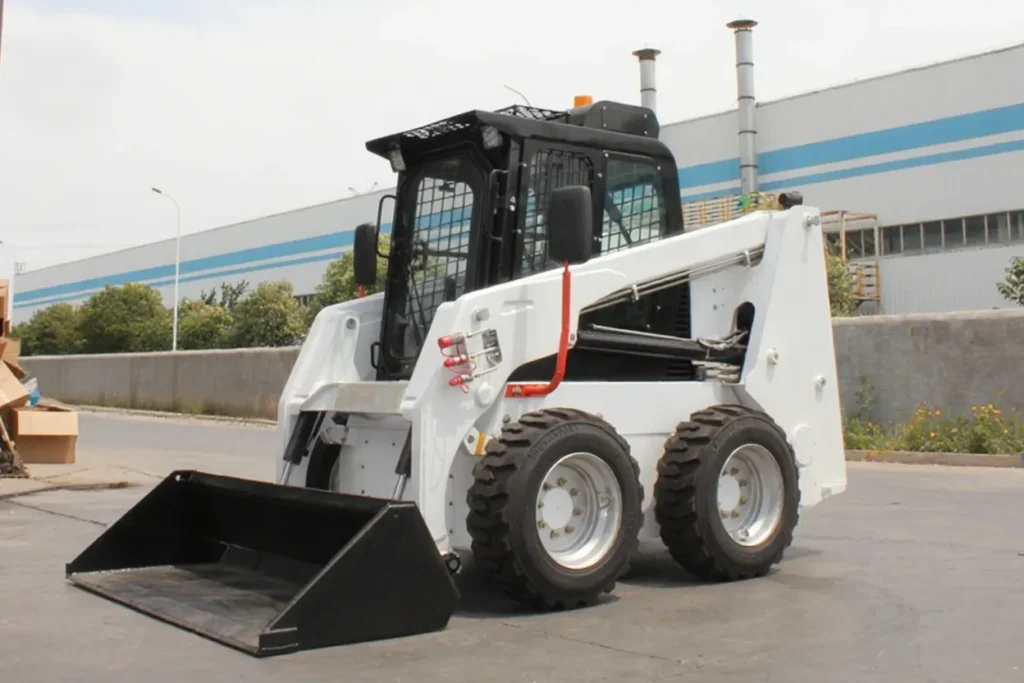
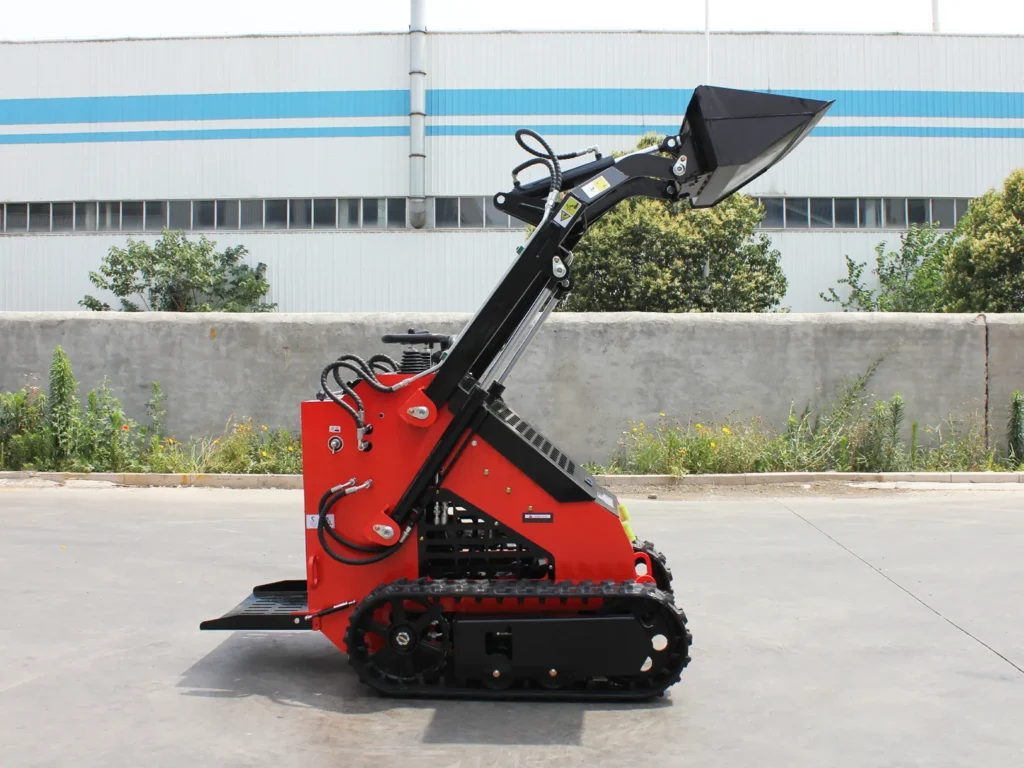
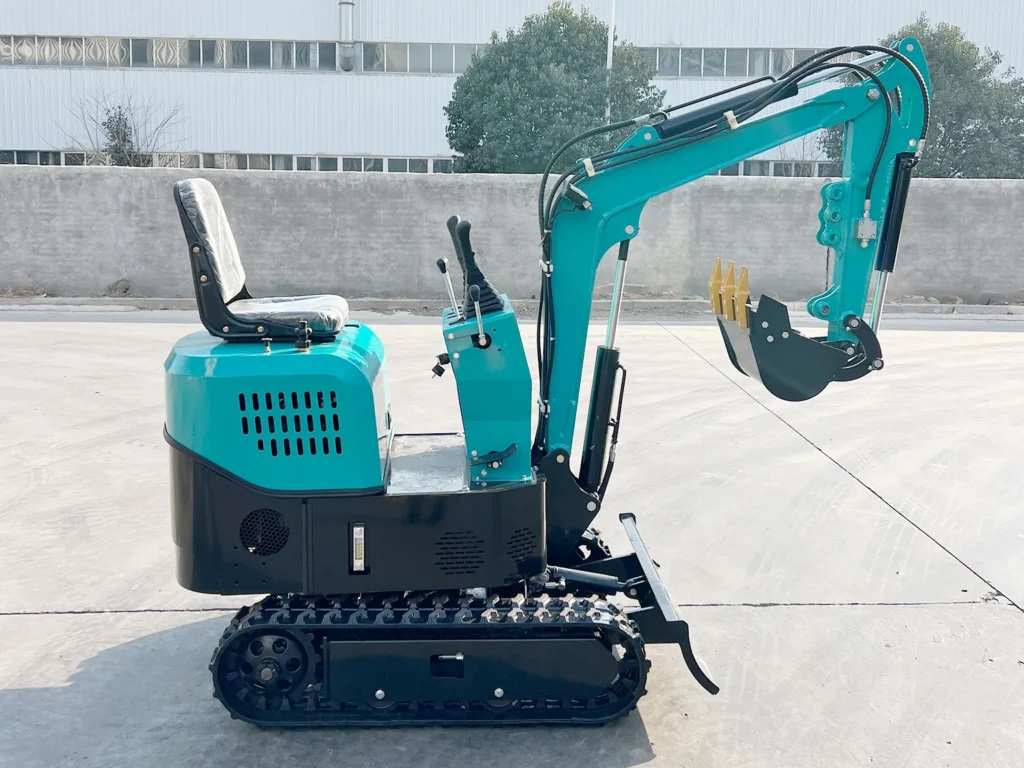
A mini excavator can remove many tree stumps, but there is no reliable stump diameter that applies to every machine and every job site.
The visible stump is only part of the work. Most of the resistance comes from the roots and the soil around them. A small stump with shallow roots in loose soil may be manageable with a compact machine. A stump of the same diameter may be much harder to remove if it has deep roots, dense hardwood, compacted clay, rocks, or limited access.
The machine also matters. Operating weight, digging force, hydraulic performance, stability, reach, and attachment choice all affect the result. A mini excavator that can reach the site may still be too light for the root system. A stronger machine may have enough force but may not fit through the entrance.
For this reason, buyers should not select an excavator from stump diameter alone. The better approach is to assess the stump, roots, soil, access, and required cleanup before choosing the machine.
Torchuck Heavy Machinery Co., Ltd. は、以下の製品を供給しています。 ミニショベル for landscaping, farming, property maintenance, rental fleets, and small construction work. The Torchuck range includes narrow-access machines and stronger compact models with different digging forces, undercarriages, engines, and attachment options.
This guide explains how to evaluate a stump-removal project, which attachments are useful, how the work is normally completed, and how to choose a suitable Torchuck mini excavator without relying on unsupported size claims.
Why There Is No Fixed Stump Diameter Limit
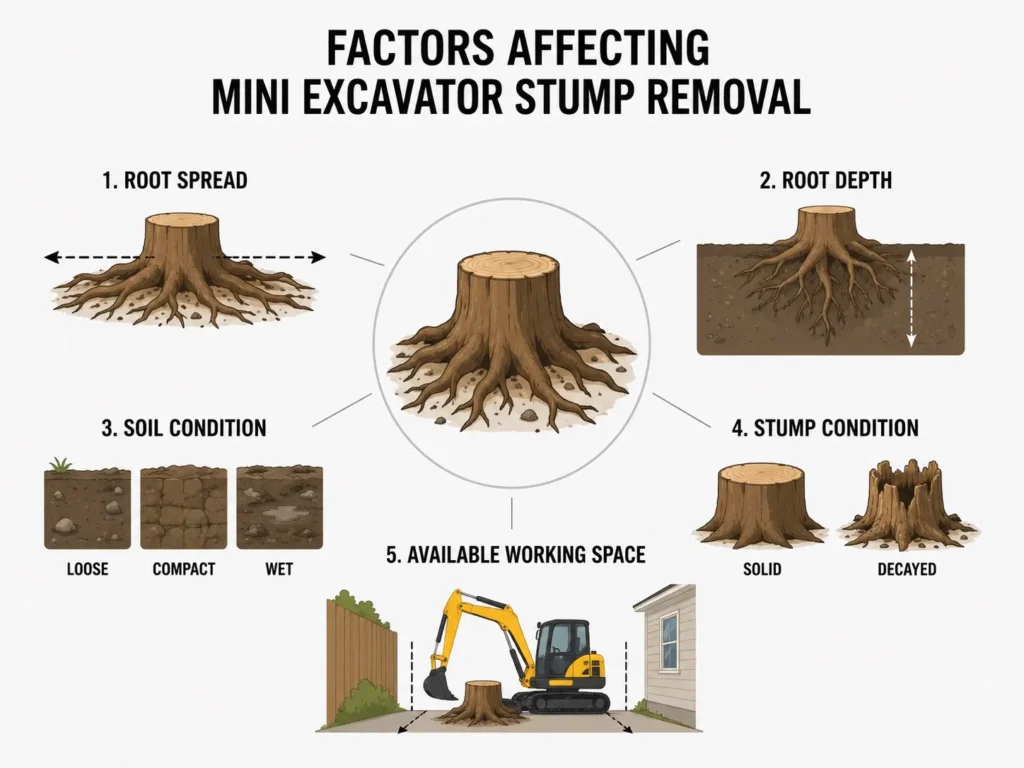
A tree stump includes the remaining part of the trunk and the roots left underground after a tree has been cut or has fallen. The roots can remain largely intact below the surface, so the visible trunk does not show the full amount of material that must be released.
Manufacturers normally publish machine specifications such as operating weight, digging force, digging depth, machine width, hydraulic system, and attachment compatibility. They do not usually provide an official maximum stump diameter.
That is because a stump is not a standardized load. Its resistance cannot be calculated from diameter alone.
A fresh hardwood stump may have strong roots that hold firmly in the soil. An older stump may be partly decayed and easier to break apart. Some trees form broad roots near the surface. Others have roots that extend deeper below the trunk.
The ground can change the job just as much. Loose soil is easier to remove from around the roots. Dry clay may hold the root ball firmly. Rocky ground can restrict bucket movement. Wet or soft ground may reduce traction and make the machine less stable.
The working area also matters. The operator may need access to several sides of the stump. A fence, wall, healthy tree, utility line, or finished garden may prevent a full excavation around the roots.
For these reasons, any table that claims a specific excavator tonnage can always remove a specific stump diameter would be misleading. Machine size can guide the selection, but it cannot guarantee the result.
When Is a Mini Excavator a Good Choice for Stump Removal?
A mini excavator is a practical option when the project needs both digging and material handling.
The machine can remove soil around the stump, expose the roots, loosen the root ball, lift or roll the released stump, backfill the hole, and grade the surface. This makes it useful for landscaping projects that include more than stump removal.
Compact dimensions are another advantage. A small machine can work in gardens, yards, orchards, farms, and areas where a full-size excavator cannot enter. Rubber tracks can also reduce damage to paving and finished ground, although the operator must still consider machine weight and ground conditions.
A mini excavator is particularly useful when the customer wants the main stump and root ball removed from the ground. This may be important when the site will be replanted, graded, drained, paved, or prepared for another structure.
However, a mini excavator is not automatically the best option for every stump. A large or mature stump may need more power than a compact machine can provide. A restricted site may not leave enough room for the boom and upper structure. A stump near a foundation, wall, pipe, or cable may also require a different method.
The correct question is not only, “Can the machine lift this stump?” The buyer should also ask whether the excavator can safely reach the stump, expose the roots, work from a stable position, and move the removed material out of the site.
Seven Factors That Determine the Right Mini Excavator
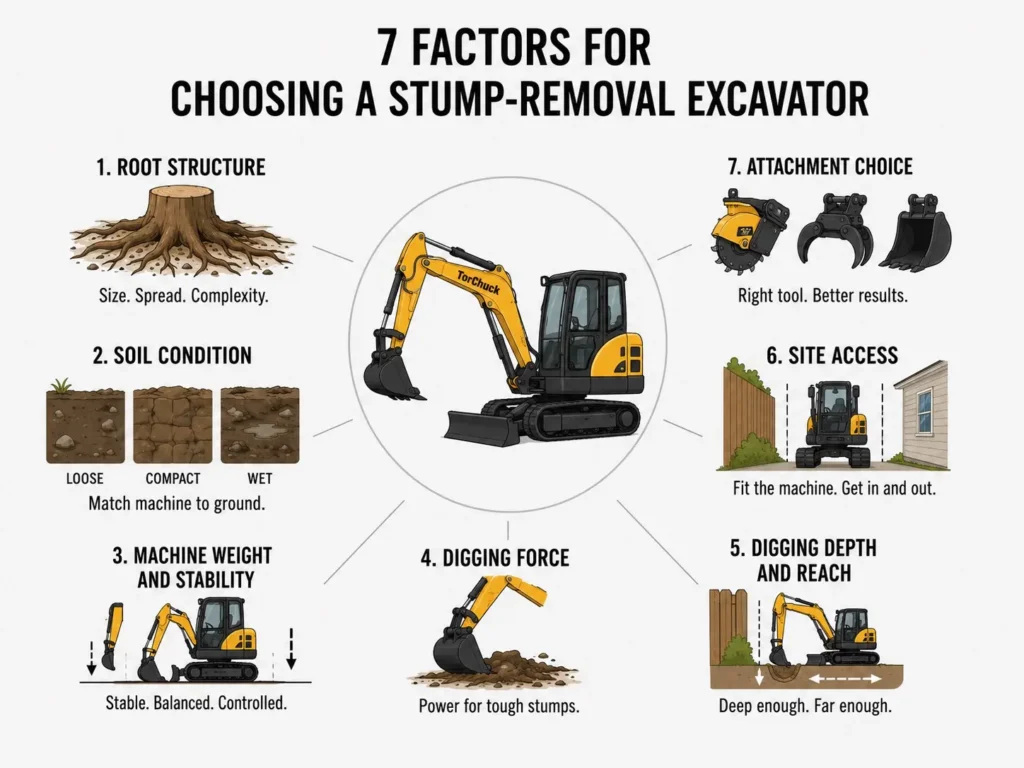
1. Root Structure
The roots create much of the resistance during stump removal.
A wide network of lateral roots may require excavation around a large area. Deeper roots may require more digging depth and repeated work from different positions. The operator must expose and release enough of the root system before trying to move the stump.
A stump that remains firm after several roots have been exposed usually still has connected roots below or on the opposite side. Applying more force without further excavation can increase stress on the machine without solving the problem.
2. Soil Condition
Soil affects both digging resistance and machine stability.
Loose soil can usually be cleared from around the root system more easily. Compacted clay may require more digging force. Stones and construction debris can block the bucket or hide roots.
Soft or saturated ground creates a different problem. The machine may sink or lose a stable working position. The operator may need ground mats, improved drainage, or another access route before starting the work.
3. Machine Weight and Stability
A heavier mini excavator normally provides a more stable base when the bucket works below or beside a stump. It can also support larger attachments.
Machine weight should still match the site. A heavier model may damage soft lawns, require a larger trailer, or fail to pass through a narrow gate.
Buyers can compare the main differences between compact weight classes in the Torchuck guide to 0.8 vs 1.5 vs 2 ton mini excavators.
4. Digging Force
Digging force affects how well the bucket or ripper can enter hard soil and work around roots.
A higher figure can help with difficult ground, but it is not a direct stump-removal rating. The operator still needs the correct attachment, stable positioning, and enough access around the stump.
The machine should work within the limits stated in its manual. Sudden pulling, jerking, or striking should not replace proper excavation around the roots.
5. Digging Depth and Reach
The machine needs enough working range to reach below the root area while maintaining a stable position.
Maximum digging depth is useful when comparing machines, but the excavator does not have the same leverage and bucket movement at every point in its working range. Buyers should allow enough capacity for normal bucket movement rather than selecting a machine that only reaches the required point at its maximum limit.
More information is available in the Torchuck guide to ミニショベルの最大掘削深度.
6. Site Access
A machine cannot complete the work if it cannot reach the stump.
The buyer should measure the gate, path, turning area, overhead clearance, and working space. The blade or attachment may be wider than the tracks. A narrow machine may fit through the gate but still lack room to rotate inside the yard.
Site photos are often more useful than a single gate measurement. They show slopes, paving, walls, trees, steps, and obstacles that can affect access.
7. Attachment Choice
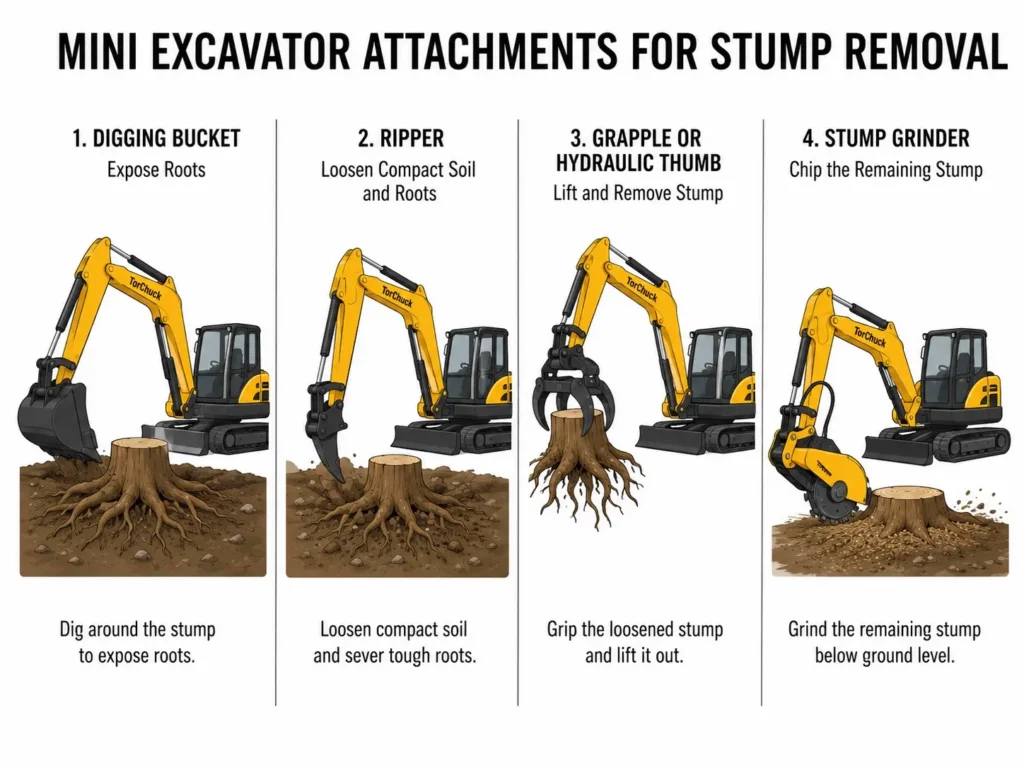
A standard bucket can expose roots and remove soil. A ripper can work through compacted ground and concentrate force around individual roots. A grapple or hydraulic thumb can help control the stump after it has been released.
The correct setup may use more than one attachment. A quick hitch can reduce the time needed to switch between tools.
Which Attachments Are Useful for Stump Removal?
Torchuck offers buckets, rippers, grapples, hydraulic thumbs, augers, breakers, and other ミニショベル用アタッチメント. The best attachment depends on the stage of the work and the selected machine.
Digging Bucket
The digging bucket is normally the main tool for opening the ground and exposing the root system.
A narrower bucket can work between roots and concentrate the machine’s digging force. It also limits the amount of soil removed from a finished garden. A wider bucket clears loose soil more quickly but may place more load on a small machine.
The bucket size must match the excavator. A larger bucket does not always improve productivity, especially in hard soil.
Ripper
A ripper has a narrow tooth that concentrates force in a small area. It can loosen compacted ground and work around roots that are difficult to approach with a wide bucket.
The ripper is not a replacement for the bucket. It does not clear loose soil as efficiently. Many stump-removal jobs use the bucket to expose the roots and the ripper to loosen the harder areas.
Grapple or Hydraulic Thumb
A grapple or hydraulic thumb helps control irregular wood after the stump has become loose.
It can hold, rotate, and move the stump more securely than an open bucket. It is also useful for handling loose roots, branches, and debris during cleanup.
The stump may carry a large amount of soil between its roots. That soil adds weight. The operator should remove loose material before moving the stump and keep the load low during travel.
スタンプグラインダー
A stump grinder uses a rotating cutting disc to chip away the wood. It removes the stump in a different way from an excavator, which normally exposes and releases the root ball.
Torchuck’s accessories range also includes a hydraulic stump grinder. Compatibility must be confirmed against the host machine, hydraulic flow, pressure, connection type, and working weight before purchase.
How Is a Tree Stump Removed with a Mini Excavator?
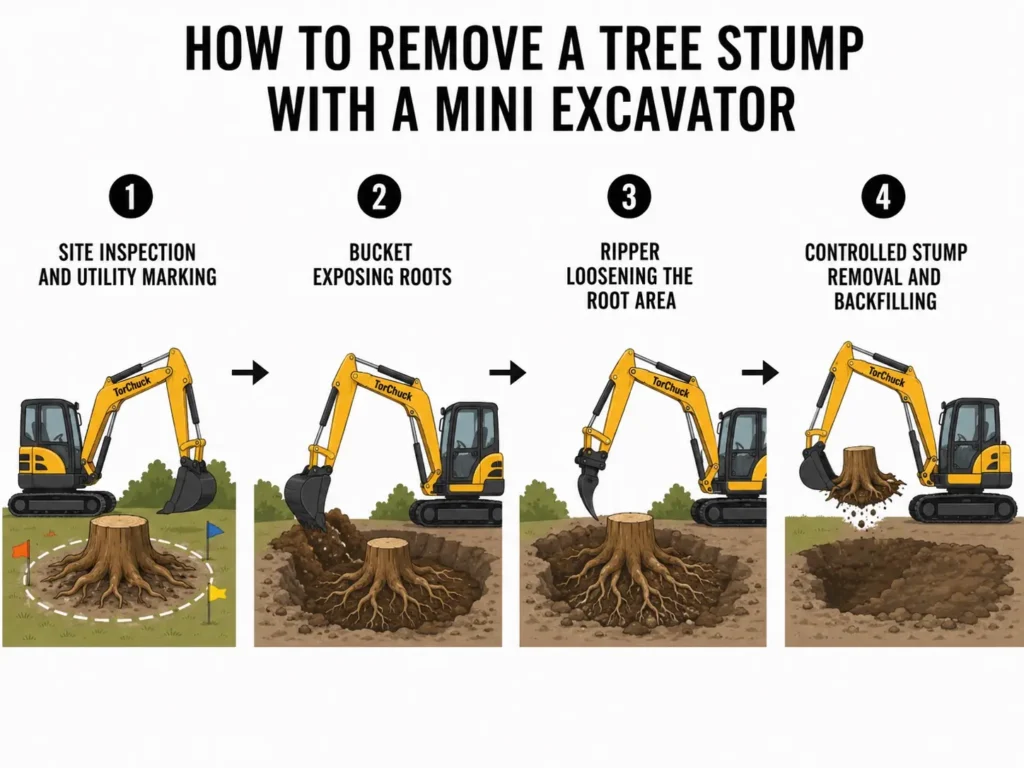
The work should begin with a site inspection. The operator needs to check the access route, machine position, nearby structures, overhead obstacles, and the area available for removed soil and wood.
Underground utilities must be addressed before excavation begins. OSHA requires the expected locations of sewer, telephone, fuel, electric, water, and other underground installations to be determined before an excavation is opened. Utility companies or owners should also be contacted under the applicable local process. Buyers outside the United States should follow the equivalent rules in their country.
The operator then clears enough soil to identify the main roots. The goal is to reduce the resistance around the root ball, not to pull against an unseen root system.
The excavator may need to work from several sides. The bucket removes soil and creates working space. A ripper may help where the ground is compacted or where a root is difficult to reach with the bucket.
The operator should test the stump with controlled movement after the main roots have been loosened. If the stump remains fixed, the work should return to excavation. More roots or soil still need to be released.
Once the stump moves freely, the bucket, grapple, or thumb can roll or lift it from the hole. The load should stay low and close to the machine. No person should stand below or close to a suspended stump or other material handled by the excavator. OSHA prohibits employees from standing beneath loads handled by lifting or digging equipment.
The final work includes removing loose roots, backfilling the hole, and grading the ground. The required finish will depend on whether the site will be planted, paved, drained, or used for construction.
How to Choose a Torchuck Mini Excavator for the Job
The safest way to choose a model is to compare verified machine specifications with the actual site. Torchuck does not assign a guaranteed stump diameter to its excavators because the stump and ground conditions can vary too much.
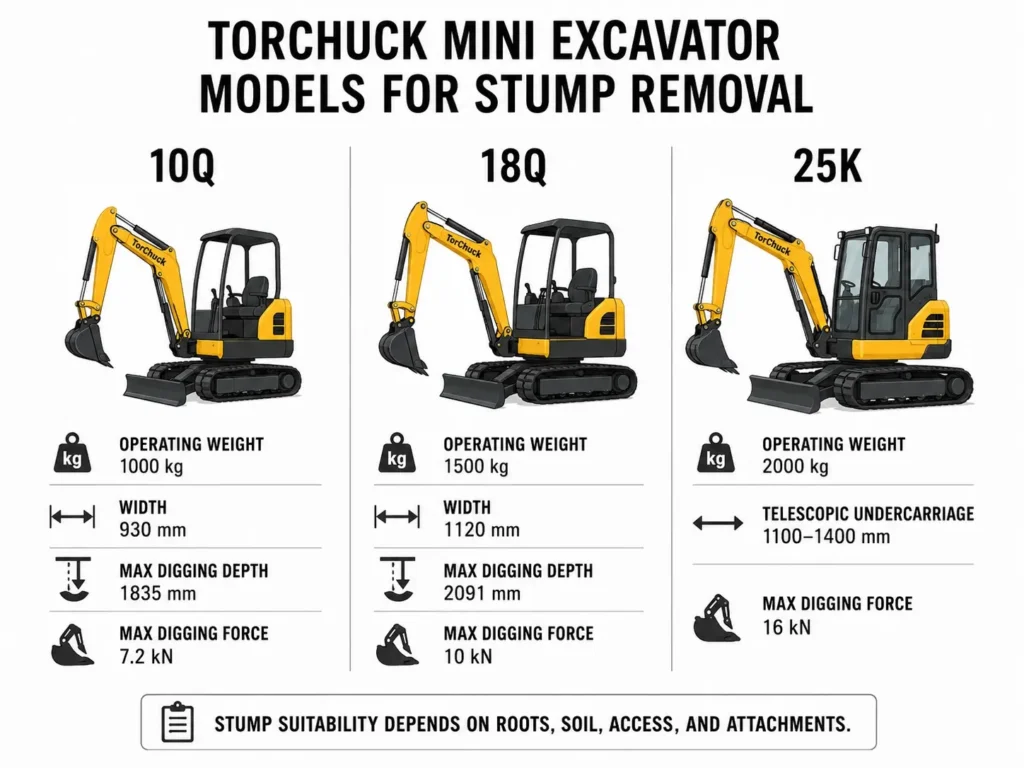
Torchuck 10Q
について Torchuck 10Q ミニショベル has an operating weight of 1,000 kg, a total width of 930 mm, a maximum digging depth of 1,835 mm, and a listed maximum digging force of 7.2 kN. It can work with a bucket, auger, breaker, ripper, rake, and other compatible attachments.
Its main advantage is access. The narrow body suits small yards, garden gates, farms, and residential landscaping areas. It is more appropriate when compact dimensions are essential and the stump-removal work is not the machine’s only task.
The specifications do not prove that the 10Q can remove a particular stump diameter. The final choice still depends on root structure, soil, working space, and the attachment.
Torchuck 18Q
The Torchuck 18Q has an operating weight of 1,500 kg, a total width of 1,120 mm, a maximum digging depth of 2,091 mm, and a listed maximum digging force of 10 kN. Its quick-coupler interface can work with augers, rippers, rakes, thumbs, breakers, and other tools.
Compared with the 10Q, the 18Q provides more operating weight and digging force. It can be considered for buyers who carry out regular landscaping and need more capability while keeping the machine compact.
Site access must still be checked because the wider body may not pass through every garden gate.
Torchuck 25K
について トーチャックミニショベル25K has an operating weight of 2,000 kg and a listed maximum digging force of 16 kN. Its telescopic undercarriage adjusts from 1,100 mm to 1,400 mm. The machine also supports attachments such as augers, hammers, and grapples.
The narrower undercarriage setting helps with access. The expanded setting provides a wider working stance. This configuration can suit contractors who need more stability and digging force for demanding soil and root conditions.
The 25K still has no official maximum stump diameter. The higher specifications only show that it offers more machine capability than the lighter models.
Mini Excavator or Stump Grinder: Which Is Better?
The correct method depends on what the customer wants to achieve after the stump is gone.
An excavator is useful when the project requires the stump and root ball to be dug out and removed. The same machine can also handle soil, roots, backfill, grading, drainage, and other landscaping work.
A stump grinder chips the wood instead of lifting the complete stump. It may be more suitable when the customer wants less excavation around the surrounding ground or when the site has limited room for a large hole.
A grinder can also be useful near finished landscaping, but underground services still need to be located before work begins. The cutting tool can extend below the visible surface.
The final ground use should guide the decision. A new planting area, foundation, drainage line, or paved surface may need more root material removed. A lawn repair may not require the same level of excavation.
Some contractors use both methods. The excavator opens the area and handles soil or larger roots, while the grinder reduces wood that is difficult to remove as one piece.
What Information Should You Send to Torchuck?
A clear model recommendation needs more than a stump diameter.
Send several photos of the stump and the surrounding site. Include a close view of the trunk and a wider view showing the available working space. Measure the narrowest entrance and note any walls, slopes, paving, steps, or overhead obstacles.
Describe the soil if possible. Tell the Torchuck team whether it is loose soil, clay, wet ground, or rocky material. Also explain whether the stump is fresh, decayed, or already partly exposed.
The sales team will also need to know how often the machine will remove stumps. A landscaper who handles occasional small jobs may need a different configuration from a contractor who carries out regular land clearing.
Include the required attachments, destination country, engine or emission requirements, and transport limits. Torchuck can then compare the site with the machine dimensions, digging force, working range, undercarriage, and attachment compatibility.
よくある質問
Can a 1-Ton Mini Excavator Remove a Tree Stump?
A 1-ton mini excavator can remove some stumps, but there is no reliable universal diameter limit. The result depends on the roots, soil, stump condition, access, digging force, and attachment.
The Torchuck 10Q provides a compact 930 mm width and a listed maximum digging force of 7.2 kN. Buyers should send site details before treating it as suitable for a specific stump.
What Size Mini Excavator Do I Need for Stump Removal?
Choose the machine from the whole job, not the visible trunk alone. Check root structure, soil, access, machine stability, digging force, reach, attachments, and transport.
A heavier machine may provide more capability, but it may also be too wide or heavy for the site.
Is a Ripper Better Than a Bucket?
The two attachments perform different tasks. A bucket is better for removing soil and exposing roots. A ripper concentrates force in a narrower area and can help loosen compacted ground around difficult roots.
Many projects use both tools.
Can an Excavator Pull Out a Stump Without Digging?
A loose, decayed, or already exposed stump may move with limited digging. However, pulling against an unknown root system can place unnecessary stress on the boom, cylinders, pins, and attachment.
The more controlled method is to expose and loosen the root system first.
Does More Digging Force Guarantee Stump Removal?
No. Higher digging force can improve performance in difficult ground, but it does not guarantee removal. Machine stability, root direction, soil, access, attachment choice, and operator technique also matter.
Should I Use an Excavator or a Stump Grinder?
Use an excavator when the project needs excavation, root-ball removal, soil handling, backfilling, or grading. Consider a stump grinder when the main task is to chip the stump with less excavation around the surrounding surface.
Can Torchuck Guarantee the Maximum Stump Diameter?
No fixed diameter should be guaranteed without assessing the site. Torchuck can recommend a machine from verified specifications and the information supplied by the customer, but actual performance depends on the stump and working conditions.
結論
A mini excavator can remove many tree stumps, but stump diameter alone cannot determine the correct machine. Root structure, soil, stump condition, access, operating weight, digging force, reach, stability, and attachments all affect the job. These factors explain why reliable manufacturers publish machine specifications rather than a universal stump-diameter rating.
A compact model such as the Torchuck 10Q offers narrow access. The 18Q provides more weight and digging force. The 25K adds a telescopic undercarriage and higher listed digging force. None of these specifications should be converted into an unsupported stump-size guarantee.
トーチック重機株式会社. can compare the actual stump and site with verified product data. Send the stump photos, entrance width, soil condition, required attachments, destination, and expected working frequency. トーチャック will recommend a suitable configuration and provide a clear quotation.